
4 Servings
I’ll be honest with you: I was not planning to publish this recipe for at least six months since I posted the recipe for spaghetti all’amatriciana quite recently and the two recipes share some key ingredients. However, things do not always go as planned. Last month, I “met” a new friend, Kimberly of WhiskeyTangoFoxtrot4, which was kind of an unexpected event for me because I’m not very social…to say the least 😉 Kimberly and her husband happened to be in Rome in the past months and her husband fell in love with spaghetti alla carbonara, one of the most famous dishes in the Roman culinary tradition.
She asked me to give her my recipe and her request was just sooooo lovely that I could not possibly say no. So, this recipe is my Christmas (or whatever different kind of festivity they may be celebrating!) present to Kimberly and her husband. I wish Roman Santa would go down their chimney and leave a warm dish under the tree, ready for them to eat in the morning (admittedly, not the perfect time of the day to eat carbonara, but who am I to judge?)… Since, however, this sounds just a little unlikely, I guess Kimberly and her husband will have to work something out in the kitchen on their own 🙂
Before we get to the “technicalities” of this wonderful culinary creation, let’s talk a bit about its origins. There are several theories about it.
Many believe that the carbonai (i.e., men who used to make charcoal) created the dish a long time ago. They used to work in the Apennine mountains and carry with them the necessary ingredients (cured pork, eggs, pasta, cheese and black pepper) to be cooked on an outdoor campfire.
According to a second theory, carbonara was created by a cook belonging to the Carbonari, an Italian secret society fighting for the independence of Italy from the Austrians at the beginning of the 19th century.
Under yet another theory, the origins of this recipe must be traced back to the Neapolitan cuisine. The XIX century cookbook “Cucina Teorico Pratica” by Ippolito Cavalcanti, Duke of Buonvicino, includes a recipe that, although far from the actual carbonara, presents a strong similarity to a dish that some consider to be the predecessor of carbonara.
A fourth theory is also known as the American theory: at the end of World War II, the Allied troops arrived in Rome bringing bacon with them. According to this theory, the American soldiers used to cook, or ask Italians to cook for them, scrambled eggs and bacon and combine them with pasta. Such combination reportedly gave Italian cooks the idea to create this classic of the Roman cuisine.
I cannot tell you which one of the above theories is accurate, since historians and chefs still debate about them. So, just embrace the theory that best satisfies your imagination and let’s start cooking, shall we? 😉
 Let’s talk about ingredients first.
One of the key ingredients of carbonara is “guanciale”, a cured meat deriving from the pork’s jowl or cheek. Unfortunately, no grocery store located in my neck of the woods knows what it is and whenever I tried to explain what I was looking for, they looked at me like I’m totally crazy (yeah, my Italian accent does not help either!) So, I had to go for a substitute which, in this case, would be pancetta, a cured meat deriving from the pork’s belly.
The other key ingredient are the eggs. In terms of number of eggs per person, every cook has their own “rule”. Moreover, some cooks use whole eggs, some cooks only yolks and some others a combination of whole eggs and yolks. Personally, I use 1 whole egg and 1 yolk for two people. When you make this dish, there is one fundamental rule to remember: under no circumstance whatsoever, should you let the eggs cook. If you let that happen, you will end up with some scrambled eggs of sort, your carbonara will be ruined and you will have no choice but to start all over.
During the years, I have heard and seen people add heavy creamy (gasp!!! May the Roman gods be lenient!) in order to make the sauce creamier: just picture me right now pushing a big red button that says WROOOOONG 😉 There is no heavy cream in the original recipe. There should be no heavy cream in your carbonara. The creaminess of the sauce is *exclusively* due to the proper use of the eggs.
As to the cheese to be used, this is an easy one: only Roman pecorino cheese.
Finally, let’s talk about seasoning. I think I have seen them all: onions, garlic, parsley, green peas and whatever the human imagination can come up with. Sorry guys. Believe me when I say that I do not mean any disrespect but once again I’m reaching for my big red button which says WRONG! The original recipe does not provide for any kind of seasoning or extra ingredients and, trust me, carbonara is just perfect the way it is – if it ain’t broken, don’t fix it kinda thing 😉
The key to the success of this very humble dish is to use top notch quality, fresh ingredients that, cooked properly, speak for themselves in a combination of flavors that creates a unique culinary masterpiece.
Ingredients:
4 slices of pancetta, ¼ inch thick
1 Tbsp extravirgin olive oil
2 whole eggs
2 yolks
14 oz spaghetti (a little less than a pack)
6 Tbsp grated Roman pecorino cheese
Salt
Ground black pepper
Directions:
Cut up the pancetta into bits (about ½ of 1 inch in size).
 In a non-stick large skillet, heat the oil, add the pancetta and fry, stirring occasionally, until the pancetta gets golden and crispy. Set aside.
Put a large pot of salted water over the stove to boil. While the water is warming up, place the whole eggs and the yolks in a bowl. Add a pinch of salt (be careful not to put too much because pancetta is already salty), 1 Tbsp of pecorino cheese, some black pepper (to taste) and whisk until you obtain a smooth mixture.
When the water is boiling, add the spaghetti and cook until al dente, stirring occasionally. Drain the spaghetti, put them in the skillet with the pancetta and toss to coat.
Transfer the spaghetti back in the large pot where you cooked them. Add the egg mixture and toss to coat (being careful not to let the eggs cook!) Add 4 Tbsp of pecorino cheese and toss to coat.
Put the spaghetti into the serving plates and dust the top of each plate with the rest of the pecorino cheese and some black pepper.
Et voilà! Simple, quick and absolutely perfect the way it is! 😉

 My parents will be arriving today from Rome to spend the holidays with us. They will be at our house at around 4 pm and the first thing my mother is going to ask for is an espresso macchiato and something sweet to eat. She is chocolate crazy like my daughter. I truly believe that the sweet tooth skipped a generation with me! 🙂 Am I the only one who would choose pizza or nachos with cheese cream (for the record, I go totally crazy about those that are sold at movie theaters) over a slice of cake or a little chocolate without even thinking about it? Anyway… since Christmas is upon us and at Christmas anyone should be on their best behavior, I decided to bake a chocolate cake to make her happy and celebrate her arrival.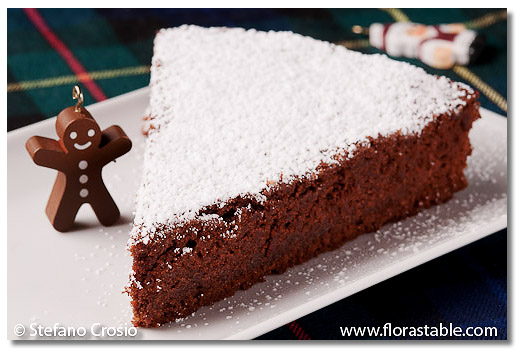















 Flora's Table