Mother’s Day and a double gift: Coco and B!

Justine Picardie's "Coco Chanel - The Legend and the Life"I know what your are thinking. Where is the food? Sorry to disappoint you, but no special dish for this occasion! Mother’s Day is a holiday that I take very seriously, which means that my family knows that I will not even put the kettle on the stove. Plus, my mom is in Rome so there will be nobody in my home who should be celebrated but me. It will be all about me! 😉

I thought this would be an ideal occasion to share a book with you that can be a perfect gift for any mom who is into fashion and wants to know more about the most iconic female figure in fashion of all times. Of course, I’m talking about Coco Chanel and the book is “Coco Chanel: The Legend and the Life” by Justine Picardie.

I simply loved this book along with the pictures and the illustrations, but my review stops here. Why? Because I cannot take any credit for “discovering” it. I bought the book after reading a post by B over at Just Add Attitude (and here it is my second gift for you all 😉 ). If you want to know more about the book, just pay a visit to B’s blog and enjoy her lovely review as well as all her other posts about the fashion guru.

Stuff We Like!Back to B and her blog: I don’t know much about B… not even her full name 🙂 but you do not have to know someone’s life, death and miracles (as the Italian saying goes) to appreciate her or him.

B is one of the most gracious bloggers out there. When you read her posts and her comments, you have the impression that she is right there with you. By following her blog, you will be taken by hand to an amazing journey through her beloved Dublin and Ireland in general. She will unveil for your all the secrets of her country, from monuments, to exhibitions, museums, workshops, restaurants, cafes, stores and farmhouses. I wish I had known B years ago when I managed to spend a month in Dublin! It would have been great to be showed around by her.

But that’s not all. Through her blog and her impeccable taste, B will also share her thoughts with you about food, style, shopping, life in general as well as picks from her two favorite cities (Paris and London – by the way, not too shabby a choice, B, if you ask me!).

So make yourself a favor: as soon as you have a moment, check Just Add Attitude out. You can thank me later. 😉

I wish you all a very happy Mother’s Day. As to me, someone in my family who is not too old and not very good at keeping secrets already told me that breakfast in bed seems to be in my cards for that day: yay! 😉
Posted in Stuff We Like | Tagged , , , , , | 33 Comments

European Wine Wars: after Tocai, it is the time of Prosek… and Teran

StefanoThe international press, Dr Vino and several other sources all recently reported that, as a result of Croatia’s imminent accession to the European Union at the end of a 10-year long process, Croatian wineries will be required to stop using the name “Prosek” to identify a traditional local sweet raisin wine that has been made for centuries mainly in the Dalmatia region from local grape varieties such as Bogdanuša, Maraština, Plavac mali and Pošip.

The reason for the requirement is that, according to EU officials, the name of the Croatian wine is too similar to Italy’s Prosecco and therefore it might be confusing to consumers. And this in spite of Prosek and Prosecco being two very different wines, made out of different grapes (Glera for Prosecco and the Croatian grape varieties mentioned above for Prosek) and in different styles (Prosecco is mostly sparkling and is not a sweet wine, while Prosek is a still, sweet raisin wine).

Unsurprisingly, the EU requirement has caused considerable commotion in the Croatian wine world and some producers indicated that the Croatian authorities are even considering initiating a legal dispute to challenge the EU requirement.

However, the chances that Croatia be allowed to retain its right to use the name “Prosek” for their wine after joining the EU are very slim, as the case is virtually identical to the one that a few years ago prevented Italian winemakers (mostly in Veneto and Friuli) from using the word “Tocai” to identify a local dry wine that had been made for centuries from the homonymous grape variety because the name was too similar to Hungary’s Tokaji, a famous local sweet raisin wine made from Furmint grapes (for more information about the Tokaji/Tocai dispute, please refer to my previous post that dealt with it).

But, as the saying goes, bad news never comes alone, at least for Croatia, that is. Beside the Prosek debacle, Croatia has to face a claim made by neighboring Slovenia that Croatia should also be prevented from using the word “Teran” to identify a red wine that is made in Italy’s region of Friuli, in Slovenia and in Croatia from the grape variety known as Terrano or Teran in Croatia. Slovenia’s claim is based on the fact that the EU granted Slovenia a protected designation of origin for Terrano grapes grown in the Slovenian region of Kras. The European Commission very recently decided the Teran dispute in favor of Slovenia, with a decision that will likely also negatively affect Italian Terrano producers.

Even in this case, the decision gives rise to many doubts, as Terrano is a very ancient variety (the oldest references date back to 1340 in Slovenia) which originated from the Karst plateau, an area that is shared among Italy (Friuli), Slovenia and Croatia (Istria). DNA profiling has also proved that Terrano is identical to Refosco d’Istria (a Croatian variety) and Refosk in Slovenia (information on the Terrano grape variety, cit. Wine Grapes, by Robinson-Harding-Vouillamoz, HarperCollins 2012).

Given the above, which side of the fray are you on?

Posted in Wine, Wine Education, WiNews | Tagged , , , , , , , | 17 Comments

An easy-peasy treat: vanilla cream berries

Vanilla cream berries2 Servings

If you have been following our blog, you know by now that I do not have a sweet tooth. Thank goodness for me and my dieting resolution, Stefano does not either. This means that, unless I’m hosting a dinner, we always finish our meals with fruit. However, every rule has an exception and our daughter is more than happy to offer us the occasion to break the routine.

Whenever she craves something sweet, I try to add a twist to her fruit. One of my “twists” is this vanilla cream that goes beautifully with any kind of berry. It takes only a few minutes to make, it’s very light (a detail not to be underestimated considering that the warm season is upon us) and when you are done gulping it down, there is hardly any sense of guilt left around… After all, you just had a bowl of fruit, right? 😉

Ingredients:

1 cup, milk
A quarter of a vanilla bean
1 egg
2 Tbsp, sugar
2 Tbsp, flour
1 cup, diced strawberries
1/2 cup, blueberries

Directions:

In a small pot, pour the milk. Cut the quarter vanilla bean in half lengthwise. With the help of a knife, gently scrape the seeds out of the bean and add the seeds to the milk. Start warming the milk on a very low heat. In a bowl, whisk the egg and the sugar. Add the flour and whisk until you obtain a smooth mixture. When the milk is hot, add the egg mixture to the milk and keep whisking for 10/15 minutes.

Put the berries in two serving bowls or glasses, pour some of the cream on top of each one and serve while the cream is still warm.

Enjoy!

Posted in Recipes | Tagged , , , , , , , , | 27 Comments

Wine Review: Coppo, Barbera d’Asti “Pomorosso” 2006 DOCG

Today we are going to talk about Barbera, and more specifically about a bottle of Barbera that I recently had the opportunity to taste and that has definitely impressed me.

The Bottom Line

Overall, I found Coppo, Barbera d’Asti “Pomorosso” 2006 DOCG ($55) to be one of the best Barbera’s that I have had so far, a wine that is a pleasure to drink and savor sip after sip – a perfect companion for a red meat dinner.

Rating: Outstanding and definitely Recommended Outstanding – $$$

(Explanation of our Rating and Pricing Systems)

About the Grape and the Appellations

As you may know, Barbera is a grape variety that is indigenous to the Monferrato district in the north Italian region of Piemonte. The first written references to Barbera date back to the end of the XVIII century. Nowadays it is the most widespread grape variety in Piemonte, from which wines are made that display lively acidity and a deep ruby color. (Note: information on the grape variety taken from Wine Grapes, by Robinson-Harding-Vouillamoz, Allen Lane 2012)

In Piemonte, Barbera is the main grape of four different appellations:

  • Barbera d’Asti DOCG (encompassing an area surrounding the towns of Asti and Alessandria, and requiring the use of 90% or more of Barbera grapes and a minimum aging of 4 months for the base version or 14 months, of which at least 6 months in wood barrels for the “Superiore” version);
  • Barbera del Monferrato Superiore DOCG (encompassing the Monferrato district near Alessandria and an area near the town of Asti, requiring the use of 85% or more of Barbera grapes and a minimum aging of 14 months, of which at least 6 months in wood barrels)
  • Barbera d’Alba DOC (encompassing an area in the vicinities of the town of Cuneo and requiring the use of 85% or more of Barbera grapes)
  • Barbera del Monferrato DOC (encompassing the Monferrato district near Alessandria and an area near the town of Asti, requiring the use of 85% or more of Barbera grapes)

Given its wide distribution, Barbera is produced in a variety of styles, ranging from simpler, “younger” versions that are only aged in steel vats to more structured and evolved versions that are aged in oak barrels, including sometimes barrique casks.

Our Detailed Review

The wine that we are going to review today is Coppo, Barbera d’Asti “Pomorosso” 2006 DOCG.

It falls within the category of the more complex Barbera’s: it is made out of 100% Barbera grapes grown in the 56 HA Coppo estate near the town of Canelli, near Asti (Piemonte). It has 13.5% ABV and is aged for 14 months in barrique casks. In the U.S., it retails for about $55.

Let me say outright that the Pomorosso is a great, structured red wine, that is suitable for several years of aging (the 2006 vintage that I had was a symphony of aromas, flavors and balance).

But let’s go more in the specifics through a technical wine tasting. As usual, I will use a simplified version of the ISA wine tasting protocol that we described in a previous post: should you have doubts as to any of the terms used below please refer to that post for a refresher.

In the glass, the 2006 Pomorosso poured ruby red and thick.

On the nose, its bouquet was intense, complex and fine with a sequence of aromas of violet, plums, blueberries, cherries, tobacco and chocolate.

In the mouth, the Pomorosso was dry, warm, smooth; fresh, tannic and tasty. It was a full-bodied, perfectly balanced wine and its mouth flavors were intense and fine, showing good correspondence with its bouquet as well as a perfect integration of the oaky notes released by its barrique aging. Its tannins, although very discernible, were also equally gentle and supple, with their delicate astringency counterbalancing the wine’s lively acidity. The Pomorosso had a long finish, with its flavors pleasantly lingering in the mouth for a very long time. Its evolutionary state in my view was mature, meaning that, with 7 years of aging under its belt, it was at or approaching its peak in terms of quality, making me think that additional aging, while certainly possible, would not likely improve its quality any further.

As usual, if you have tasted Pomorosso before, let me know how you liked it!

Posted in Red Wines, Wine, Wine Reviews | Tagged , , , , , , , | 11 Comments

What happened to fairy tales? A review of “The Fairy Tales of the Brothers Grimm”

The Fairy Tales of the Brothers GrimmReading has been one of my greatest passions my entire life. I love everything about books. To be completely honest, I do have a sort of fetish obsession with books as objects. I love their shapes and the shivering feeling that certain covers can give me. I look forward to starting a new book waiting, with trepidation, to find out what kind of world that particular book is going to unveil to me. If I see a damaged book or whose pages have been torn or dogeared, I feel a physical pain and I end up wondering what kind of human being is capable to “treat” a book like that. 😉 I have the utmost respect for books and I think they should be treated as very precious items.

As a parent, I think it is my duty and my privilege to teach my daughter the importance and the beauty of reading and how books make you learn and understand many things and, therefore, ultimately make you a better person. Fortunately, my daughter loves reading and reading has become an integral part of our daily routine – plus, I do not recall a time when I said no to my daughter asking me to buy her a book.

Having said that, you can now understand my happiness when I came across “The Fairy Tales of the Brothers Grimm”. The purple cover along with the lovely illustration of Sleeping Beauty can by themselves give you a taste of the magic and the beauty that the book contains: it is an amazing collection of twenty-seven of the most enchanting Brothers Grimm’s fairy tales brought together to celebrate their 200th anniversary. There are the most famous fairy tales such as Cinderella, Sleeping Beauty and Snow White, all “restored” to their original version, as well as lesser-known but, certainly, not less magical tales such as The Golden Goose and The Fisherman and His Wife.

The tales are accompanied by superb vintage illustrations made by important visual artists from the 1820s all the way up to the 1950s. They are so beautiful and unique – the kind of artwork that any mother dreams to decorate her daughter’s bedroom with.

From The Fairy Tales of the Brothers Grimm: Snow WhiteDuring the last few years, we have been watching adaptations of The Prince Frog and Rapunzel that went so far from the original version that I’m pretty sure the poor Brothers Grimm could not help but turn in their graves. The female heroines are pictured as some sort of warriors who want to be always in control and believe they know everything but have nothing of the grace and the magic of the original princesses. They are so strong-willed and stubborn that they would emasculate the strongest of the princes!

Do not get me wrong: I do think that women should be strong, independent and self-sufficient, but I am a firm believer that, at least in fairy tales, it is the prince that should fight the dragon and the princess the one who must be rescued. After all, deep inside, isn’t that what every woman dreams of when she is a little girl and, maybe, even afterwards? I really thought it was time to find the flavor of the ancient tales once again and that’s exactly what this book will do for a little girl: open the door to a lost yet enchanting world whose memories will accompany her during the life journey.

Stuff We Like!This is a perfect book for your daughter, niece, granddaughter, your best friend’s child and for any other girl who is willing to dream. However, be mindful that the fairy tales in the book are the original version that was written by the Brothers Grimm, which departs from the milder “Disney-format” adaptations that we are all used to and may therefore make them more suitable for older children who have the maturity to elaborate their contents and put them into context.

I hope you will enjoy it as much as my daughter and I are!

Have a wonderful week.

Posted in Stuff We Like | Tagged , , , , , | 25 Comments

Wine Review: Donnafugat​a, Contessa Entellina Bianco “Chiarandà” 2009 DOC

Donnafugata, Contessa Entellina Bianco "Chiarandà" 2009 DOCOn a previous post, we have talked about how Chardonnay is successfully grown in various regions throughout Italy, literally from Valle d’Aosta in the north to Sicily in the south, and how several Italian wineries make some excellent wines from such a widely cultivated international variety.

Very broadly speaking, I have to say I rather review and promote wines made out of Italian indigenous grape varieties, essentially because they differentiate themselves from the ubiquitous international varieties, because there are many excellent ones and because, by so doing, I think I am giving my small contribution to preserve biodiversity also in the vineyard (a wine world populated only by Chardonnays, Sauvignons, Pinots and Merlots would be a pretty boring one, if you ask me!) and to make certain Italian wines better known outside of Italy.

However, it is undeniable that certain international varieties have been successfully grown in Italy and that excellent, elegant wines are made out of such grapes which oftentimes are not very well known to the general public.

So today’s review is of a Sicilian Chardonnay that I very much like and that illustrates the point that Chardonnay is an extremely versatile variety that can give excellent results even in warmer climates like Sicily’s.

The wine I am talking about is Donnafugata‘s Contessa Entellina Bianco “Chiarandà” DOC 2009 ($35).

The Bottom Line

Overall, I very much enjoyed the Chiarandà, which I found to be a very elegant and “clean” Chardonnay, in which its oaky notes are not dominant but rather very well integrated such that they add to (instead of overwhelm) its pleasantly fruity and mineral flavor palette.

Rating: Very Good and definitely Recommended Very Good – $$

(Explanation of our Rating and Pricing Systems)

About the Producer and the Wine

Founded in 1983, Donnafugata is one of the top Sicilian wineries that contributed to the “Sicilian wine revolution” by contributing passion, investments and professionalism to raise the profile of Sicilian winemaking and produce top quality wines.

Their Chiarandà is a 100% Chardonnay wine made from the grapes grown in Donnafugata’s vineyards in a hilly region of the Contessa Entellina DOC appellation near the homonymous town (about halfway between Marsala and Palermo), in the western part of Sicily, at an altitude between 200 and 600 mt (650 to 1,950 ft) above sea level. The vineyards from which Chiarandà is made achieve an excellent density of 4,500 to 6,000 vines/HA and the vine training system used is spurred cordon.

The wine has 13% ABV and is fermented in stainless steel vats and then undergoes 6 months of aging on its lees in a mix of concrete and oak vessels of various sizes plus 24 additional months of in-bottle fining. Given its lively acidity (see, tasting notes below) it is a wine with great aging potential, in the 10 year range. In the US, the Chiarandà retails for about $35.

Our Detailed Review

Let’s now get down to the actual review of the 2009 Chiarandà that I had. As usual, I will use a simplified version of the ISA wine tasting protocol that we described in a previous post: should you have doubts as to any of the terms used below please refer to that post for a refresher.

In the glass, it is a beautiful golden yellow in color, and thick when swirled.

On the nose, its bouquet is intense, fine and definitely complex, with an array of enticing aromas of peach, tangerine, butter, vanilla, herbs (sage), mineral and iodine notes.

In the mouth, the wine is dry, warm, smooth; with lively acidity and pronounced minerality. It is medium to full-bodied with good structure and very balanced, with intense and fine mouth flavors reminiscent of its aromatic palette and a long finish, with those flavors pleasantly lingering in the mouth long after gulping down a sip. Its evolutionary state was ready (meaning, fine to drink now, but can take two or three more years of aging without compromising its qualities).

As usual, if you have tasted Chiarandà before, let me know how you liked it.

Posted in White Wines, Wine, Wine Reviews | Tagged , , , , , , , | 16 Comments

Tomato green beans and the need to spice my diet up

Green beans and tomatoesSpring is a synonym of many things to me. One of those things is… diet. Yup, spring coincides with the opening of my dieting season. My season usually lasts about three months. Why? Because at the end of June, I will go to Italy for a summer vacation and face the judgment of the fiercest people on earth: my so-called friends and acquaintances. They will greet me with one eye and with the other eye they will weigh every single organ of my body to check if I gained weight during the last year.  😉

I know what you are thinking: I shouldn’t care but I do and, to be honest, I dare anyone to find a woman who deep inside doesn’t. Plus, Italian women are all about being skinny and in shape and I’m afraid I’m not different. Unfortunately, I do not belong to that category of women that lose weight just breast-feeding or chasing their kids (by the way, have you ever met one of those women in real life?) Shedding even a single pound requires a Gargantuan effort on my part and year after year it is getting harder and harder and the results less and less satisfying. I guess it is the aging factor along with the metabolism slow-down that I just cannot defeat. 😉

Anyway, a few days ago, I was about to eat the nth, very-sad looking plate of steamed green beans while I was asking myself what I did wrong to deserve such a punishment. Then I remembered a very simple yet tasty recipe for green beans that my mom used to make a few years ago. Of course, next thing I did was asking her to refresh my memory about the details of her recipe.

Sure, it has a few more calories than a mere steamed green bean dish, but at least it is something to look forward to eating either at lunch or dinner without feeling too guilty 😉

Ingredients:

1/2 cup, extravirgin olive oil
1 garlic clover
4 cups of green beans
10 cherry tomatoes
1/4 cup, capers (optional)
red pepper flakes
salt

Directions:

Green beans and tomatoesCut the tomatoes in halves. If you decide to add the capers, remember to put them in a cup with some water at least 20 minutes before using them and then to rinse them under some tap water before putting them in the skillet.

Put the olive oil and the garlic in a large non-stick skillet and brown the garlic. When the oil has gotten the garlic flavor, throw the garlic away and add the tomatoes and some salt (to taste). Toss to coat and cook, on a very low heat, for about 5 minutes.

Add the green beans, the capers and some red pepper flakes  (to taste) and toss to coat. Cook on a very low heat, stirring occasionally, for about 20/30 minutes.

To those of you who are in my shoes, I wish you a very happy dieting! 🙂

Posted in Recipes | Tagged , , , , , , | 40 Comments

Wine Review: Two Italian Dry Rieslings Made by Elena Walch and Abbazia di Novacella

I am writing this review with some trepidation as I know that most likely it will be read by fellow wine blogger and friend Oliver who authors the very enjoyable and educational blog The Winegetter (if you do not follow him already, I sure think you should!) and, most importantly, is definitely an authority when it comes to Rieslings! I think I know that his preference goes to German sweeter Rieslings, while the two wines that I am going to review today are both Italian dry Rieslings from the Alto Adige area of the Trentino Alto Adige region.

And now on to the reviews of the two wines that I tried. As usual, I will use a simplified version of the ISA wine tasting protocol that we described in a previous post: should you have doubts as to any of the terms used below please refer to that post for a refresher.

1. Elena Walch, Alto Adige Riesling “Castel Ringberg” 2010 DOC (12.5% ABV; ab. €15 in Italy)

Elena Walch, Alto Adige Riesling "Castel Ringberg" 2010 DOCElena Walch is one of my favorite producers of white wines from Alto Adige and, let me say it upfront, her Castel Ringberg did not disappoint me!

This is a single vineyard wine made of 100% Riesling grapes grown in the Castel Ringberg vineyard near the town of Caldaro. It was fermented and rested on its lees exclusively in stainless steel tanks. Unfortunately, although other Elena Walch’s wines are available in the US, this wine does not appear to be, which is a shame.

In the glass, the wine was straw yellow and quite thick.

On the nose, its bouquet was intensecomplex and fine, with pleasant aromas of petrol (very discernible), followed by grapefruit, citrus, pear, minerals and herbs.

In the mouth, it was dryquite warmsmoothfresh and tasty, with medium body. The wine was balanced, with intense and fine mouth flavors that trailed the wine’s bouquet. It had a long finish and it was ready in terms of its evolutionary state.

Overall, a very pleasant, fresh dry Riesling with a captivating bouquet.

Rating: Very Good Very Good – €

(Explanation of our Rating and Pricing Systems)

2. Abbazia di Novacella, Alto Adige Valle Isarco Riesling “Praepositus” 2009 DOC (13% ABV; ab. $35 in the US)

Abbazia di Novacella, Alto Adige Valle Isarco Riesling "Praepositus" 2009 DOCThis wine is part of Abbazia di Novacella’s premium line “Praepositus”. It is made of 100% Riesling grapes, grown in vineyards with an outstanding density of 6,000 vines/HA and harvested for 2/3 in October and 1/3 in December (late harvest). It was fermented in stainless steel vats and aged in bottle for 9 months before being released to the market.

In the glass, the wine was straw yellow with greenish hintsquite thick.

On the nose, its bouquet was intensequite complex and fine, with aromas of petroleum, grapefruit, lime and Granny Smith apple.

In the mouth, it was dryquite warmquite smoothfresh and tastymedium-bodied. The wine was balanced, with intense and fine mouth flavors. It had a long finish and was ready as to its evolutionary state.

Overall, another very pleasant dry Riesling, although it personally impressed me a touch less than the Castel Ringberg, especially due to its narrower bouquet.

Rating: Good to Very Good Good to Very Good – $$


(Explanation of our Rating and Pricing Systems)

At any rate, two Italian dry Rieslings that I would certainly recommend and that I am pretty sure would not disappoint you.

That’s all for today! As always, if you have tasted either one (or both!) of these wines, make sure to share your thoughts by leaving a comment below!

Posted in White Wines, Wine, Wine Reviews | Tagged , , , , , , , | 8 Comments

A Food Photography Primer

Over time, a few readers of this blog who seem to have been enjoying my food images have been asking that I write a post with a few pointers about food photography: today is the day for that. Bear in mind that what follows is not intended to be a comprehensive course on food photography, but just a reflection on some basic rules of photography that play an important role in making a good food photograph.

There is no magic, food is just one of the subjects of studio photography and food photography is still photography, so the same basic principles apply. As such, there are three main guiding criteria that everyone with an interest in food photography should focus on:

1. Composition
2. Lighting
3. Post-Processing

Let’s take a closer look at each of them.

1. Composition

Composition is an element that can literally make or break a photograph. A successful image, including one of a food item, needs to have a strong, clean, balanced composition or it will look flat and boring at best. Here are a few pointers as to how to tackle this aspect:

  • Devise a plan before your shoot: pre-visualize how you would like your image to look like and figure out what you need to accomplish your vision (in terms of props, lighting, background and focal length of your lens)
  • Set up well ahead of time, when you have no time pressure: the shoot should be set up according to your plan and your vision, with everything in place except the food you are going to photograph. Take a few test shots in the same light that you would use for the real thing and see how your image looks like through the lens you chose. Use this opportunity to find out what does not work and to move things around or change camera/lighting settings until you achieve a pleasing composition that conveys your vision. Add the actual food item to be photographed only when you are all set and ready to go, so when you photograph it, it is going to be perfectly fresh, in top condition
  • Although composition is subjective and should convey your own vision, there are a few “rules” that will generally make your image a stronger one, including the following:
    • Less is more: keep your composition clean and simple;
    • Compose in such a way that the main subject of your image is immediately obvious to everyone;
    • Avoid blank space near the edges of your frame: make sure that your subject and other meaningful elements of your composition fill the frame in a balanced and pleasing way, making sure that you have a strong foreground, middle ground and background in your image;
    • Very rarely does a subject that is in the smack center of your image look good (unless you are going for an extreme close-up where your subject fills the entire frame): try to create some more dynamism by for instance resorting to the rule of thirds, that is placing your main subject off center, near one of the corners of your frame, or positioning important elements in the frame along an imaginary diagonal line;
    • Know your camera’s commands well and select a focal length and an aperture suitable for what you are trying to accomplish: do you want to achieve a compressed look with quite shallow a depth of field? Select a telephoto lens. Do you want to place a strong subject in the immediate foreground in the context of a wider scene with greater depth of field and a clearer sense of depth? Go for a wide angle lens. Do you want more depth of field? Select a smaller aperture (bigger f/stop number). Do you want only a narrow area in your image to be in sharp focus with the remainder being rendered as a soft blur? Pick a large aperture (smaller f/stop number). Every tool (i.e., your lenses) should be used for the purpose it is intended for and ultimately to realize your vision.

2. Lighting

Lighting is the essence of photography (the very word “photography” comes from Greek and means “writing with light“) and yet it is an often overlooked component in a photograph. Almost never will a photograph taken in bad light look good. Once again, here are a few things to bear in mind while you are planning for your shoot:

  • If you want to photograph using natural lightnever set up in direct sunlight (you would end up with harsh, unattractive contrast) – prefer the light of an overcast day or light coming from a northern facing window or skylight, but be prepared to supplement it with some extra light source so as to avoid that the image looks too flat – also, be ready to use a tripod (especially if youintend to use a smaller aperture) as your shutter speed will likely be fairly slow, unless you crank up the ISO which however may end up in a noisy (as in, grainy) image
  • Stay away at all costs from your camera’s pop-up flash and never place a flash head directly onto your camera’s hot shoe as this arrangement would give you flat, unattractive front light: remember, photography (like painting) is the art of creating the illusion of a 3D object in a 2D medium, and the key to achieve that is creating visible, pleasing shadows in your image
  • In order to create visible shadows you need to ensure that your main light source (AKA your key light) is off axis with your camera: side lighting and backlighting are both effective ways to create shadows
  • Generally, in food photography you want to achieve soft shadows and stay away from harsh, unpleasant shadows. The way to do this is to use a large light source or, if you don’t have one, to make your light source as big as you can: remember, the bigger the light source, the softer the shadows it will cast. This is why photographing food (or making people portraits) in natural light on an overcast day is something appropriate: thanks to the cloud cover, the sky turns into a gigantic source of diffused, soft light. In the studio, soft light can be achieved in several ways: by using a light modifier, such as a soft box (essentially, a big diffuser) or an umbrella (a reflector) or (assuming you have white walls and ceiling) by bouncing the light of your flash head off a wall or the ceiling
  • If you need to open up a bit the shadows that you have created, so as to reduce the contrast and provide more detail in the parts of your image that are in the shadow, you should use a fill light, which is another light source coming from a different direction and with a lesser intensity than your key light (you don’t want to obliterate your shadows altogether, you only want to make them lighter): a second flash head at a weaker setting or a reflector that bounces some of the light coming from your key light back into the scene are both good solutions to achieve this (tip: some aluminum kitchen foil crumbled and then flattened out works fairly well as an improvised silver reflector)

3. Post-Processing

Neither in the “good ol’ days” of film-based photography nor in nowadays digital photography world will a great image come straight out of the camera. While the old GIGO rule still applies (Garbage In, Garbage Out – meaning, if you start out with a bad image, it will be very difficult that you may turn it into a good one in post-processing alone), even a very solid image out of the camera will require some extent of post processing to become a great photograph. A few tips:

  • Shoot RAW, not Jpeg: by shooting RAW you will retain the maximum flexibility on your files and will not have to live with choices irreversibly made by the camera – the possibility of changing your white balance into whatever light temperature you desire is by itself totally worth the choice of shooting RAW instead of Jpeg
  • Learn how to use at least the basic features of Photoshop (or whatever other image editing software of your choice): at a minimum, learn how to crop your image (should you need to); how to work with levels and curves and with the dodge/burn tool to control contrast and exposure; how to use the saturation and color balance commands to control color; how to effectively sharpen an image; and finally how to work with layers so every change you make can be reversed at a later time if need be
  • Generally, be subtle with your changes and only aim them at optimizing your image so as to extract all of its potential from that digital file and turn a good image into a great one.

That’s it! I hope the above may be of help or inspiration to some of you to push the envelope a little bit and try to apply all or some of the above tips to your own food photography and see what comes out of it. And especially, have fun in the process and experiment!

If you are interested in seeing more of my food images, feel free to check out my photography Web site.

Posted in Uncategorized | Tagged , , , , , , | 14 Comments

Sea Scallops with Olives and Potatoes – Recommended Wine Pairing

Les Crêtes, VdA Chardonnay Cuvée Bois DOCI am still slowly catching up with my overdue wine pairings… Today we will suggest a wine that pairs well with Francesca’s delicious recipe of sea scallops with olives and potatoes.

Based on the ingredients and preparation of Francesca’s sea scallop dish, its main features from a sensory perspective are latent sweetness, latent sourness, tastiness, flavor and a slight greasiness in a fairly structured dish. In light of the ISA wine pairing criteria (in case you forgot or missed my post about them and are interested in knowing more about them, you may want to go back or anyway refer to it), the wine to complement such dish will need to possess good acidity, smoothness, intensity of nose-mouth flavors, good ABV and a decent body/structure.

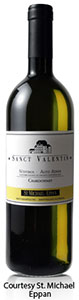
St. Michael-Eppan, A.A. Chardonnay Sanct Valentin DOCBased on those characteristics, I would go for a structured Chardonnay with some oak-aging and good acidity.

As I mentioned previously on Flora’s Table, it is worth mentioning that in Italy you can drink very good Chardonnay pretty much across the entire Italian territory, literally from Valle d’Aosta to Sicily. This is because, thanks to the great versatility and adaptability of this international grape variety, Chardonnay has been very successfully grown in very different terroirs in North, Central and even Southern Italy.

My recommendations below of most of my all-time favorite Italian Chardonnays will prove the point that I just made, as you will notice that they actually take you on a virtual tour of Italy:

Elena Walch, A.A. Beyond the Clouds DOCLes Crêtes, Valle d’Aosta Chardonnay “Cuvée Bois” DOC from Valle d’Aosta (100% Chardonnay; in my view a phenomenal wine with a wonderful bouquet of wildflowers, jasmine, pineapple and butter – hats off to the producer who invested the energy and resources necessary to achieve a density of 7,500 vines/HA in the vineyard used to create this magnificent wine – the only problem is the absurd price this wine generally retails for in the US, which, at around $80, is about twice as much as what you would pay for it at a wine store in Italy)

St Michael-Eppan, Alto Adige Chardonnay “Sanct Valentin” DOC from Alto Adige (100% Chardonnay; with scents of Mirabelle plum, butter, vanilla and almond)

Elena Walch, Alto Adige “Beyond the Clouds” DOC from Alto Adige (“predominantly” Chardonnay blended with other white grape varieties based on a proprietary recipe; with scents of peach, pineapple, almond, butter and vanilla)

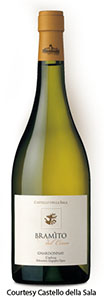
Castello della Sala, Bramito del Cervo Umbria IGTJermann, “W? Dreams” Venezia Giulia IGT from Friuli Venezia Giulia (97% Chardonnay, 3% other grape varieties kept it a secret by the winery; with aromas of Mirabelle plum, citrus, vanilla and a smoky hint – a special note of merit to the producer who achieved a density of almost 8,000 vines/HA in the vineyards used to create this excellent wine)

Tenute Folonari, “La Pietra” Tenute del Cabreo Toscana IGT from Toscana (100% Chardonnay; with scents of peach, butter, honey, hazelnut and flint)

Castello della Sala“Cervaro della Sala” Umbria IGT from Umbria (a blend of 90% Chardonnay and 10% Grechetto aged in barrique casks for 6 months; with fine aromas of citrus, pineapple, butter, honey and hazelnut)

Planeta, Chardonnay Sicilia IGTCastello della Sala, “Bramito del Cervo” Umbria IGT also from Umbria (100% Chardonnay, the “little brother” of the Cervaro della Sala; with fine aromas of wildflowers, pineapple, Mirabelle plum, butter, vanilla and hazelnut – a quality Chardonnay with a good QPR)

Planeta, Chardonnay Sicilia IGT from Sicily (100% Chardonnay; with complex and elegant scents of wisteria, peach, apple, honey, butter, vanilla, hazelnut and chalk)

Tasca d’Almerita, Chardonnay Sicilia IGT also from Sicily (100% Chardonnay; with fine aromas of broom, peach, pineapple, banana, herbs, vanilla and a toasty hint)

Enjoy, and as always, if you happened to try out any of these wines,  let me know how you liked them!

Posted in Wine, Wine Pairings | Tagged , , , , , , , | 24 Comments