Saint Emilion Chronicles #4: His French Heaven

FRANCE, Montagne: Château Saint Jacques Calon, Stephane Gabart's wonderful B&B

After presenting a little bit of Saint Emilion in general, one of its magnificent churches and Saint Emilion’s sweet treats on previous posts, time has come to unveil the little “secret” about where we stayed during our visit: but of course, we had no hesitation to email fellow food blogger, cook, photographer and aesthete Stephane Gabbart, who authors the sleek and elegant blog “My French Heaven” and operates a wonderful B&B in the vicinities of Saint Emilion!

FRANCE, Montagne: The common areas at Château Saint Jacques Calon

Stephane’s family have been Bordeaux wine merchants for generations, but he decided to follow his own call and study cooking and Hotel Management in Lyon under uber-famous French Chef Paul Bocuse. After completing his studies, Stephane worked for 10 years for Ritz-Carlton at several of their locations in the US. Then in 2005 he headed back to France, where he started operating a B&B in his beautiful family property near Saint Emilion and later on he founded his wonderful blog, My French Heaven.

FRANCE, Montagne: Details of the common areas at Château Saint Jacques Calon

In case you are not following Stephane’s blog yet, do yourself a favor and check it out as it really is exceptional, in terms of both learning authentic, delicious French recipes and soothing your eye with Stephane’s outstanding food photography.

FRANCE, Montagne: The pool area at Château Saint Jacques Calon

FRANCE, Montagne: Details of the common areas at Château Saint Jacques CalonBut back to Stephane’s B&B and our stay: the property is called Château Saint-Jacques Calon and is located in the town of Montagne, a short 5 minute drive from Saint Emilion (for driving directions or reservations, check out the B&B’s Website). Montagne is a beautiful small town in its own right, as I will show you on a future post. The B&B is nothing short of phenomenal, inside and out, as you can tell from my photographs that illustrate this post. The chateau is a large family house with a beautiful front yard and a neatly manicured inner yard with a large swimming pool, right by which the most delicious continental breakfast is served in the mornings of the warmer months of the year.

FRANCE, Montagne: The common areas at Château Saint Jacques Calon

FRANCE, Montagne: Details of the common areas at Château Saint Jacques CalonStephane is the most gracious host and goes out of his way to personally ensure that your stay is as satisfactory and pleasant as possible. He even takes care of selecting the freshest ingredients for breakfast himself: that baguette… those fruit preserves… that fresh seasonal fruit… hmmmm… Everything was so wonderfully exquisite!

Beside that, Stephane is more than willing to help as necessary, including by recommending great restaurants and the best wine store in Saint Emilion (more on that on later posts) and getting to the point of escorting us on a mini-trip to visit the nearby Libourne food market! Of course, Stephane’s English is flawless and, I have to say, so are his map-drawing skills: he charted out our route to a local restaurant in a nearby village with Google-Earth precision! 😉

FRANCE, Montagne: The common areas at Château Saint Jacques Calon

To top it all of, Stephane is a real pleasure to spend time with, very personable and incredibly kind to all his guests. A true French gentleman. Plus, he offers fellow bloggers a discount off the regular B&B rates and, for those who may be interested, guests may also sign up for French cooking classes with him.

Thank you, Stephane, for making our stay in Saint Emilion so pleasant and productive! 🙂

Posted in Stuff We Like | Tagged , , , , , , , , , , , , | 25 Comments

A haunting memory: apple and speck risotto

Apple and speck risotto2 Servings

Have you ever happened to go to a restaurant or a dinner party and eat something that “shocked” your taste buds so much (in a positive way, I mean) that the memory of that dish has been haunting you ever since? That’s exactly what happened to me a few Christmases ago.

We were spending our holiday vacation in Courmayeur, a gorgeous ski resort located in Val d’Aosta, a mountainous region in northern Italy, at the foot of the Mont Blanc. One evening, famished after an entire day of skiing, we were enjoying dinner at one of the lovely restaurants in town. After carefully reading the menu, my father announced that he was going to order the apple and speck risotto. Just the idea sounded really promising and intriguing. We were not disappointed. The contrast between the tastiness of the speck (a type of dry-cured, smoked ham) and the sweetness of the apple was a match made in heaven!!!

I’ll never forget that risotto. The “version” that we tasted was made with Granny Smith apples, but the original recipe, that originates from Trentino Alto-Adige, another region in northern Italy, actually calls for Golden Delicious apples that are extensively grown in that region.

I have been meaning to make this risotto for quite some time and, eventually, I felt “inspired” to give it a try. Hauted by the memory, I decided to use some Granny Smith apples (which, by the way, are my favorite kind of apples) but feel free to use the kind of apples you like the most.

I’m really happy of how this risotto turned out. We all loved it so much that it has now found a regular place on our table. Here is the recipe – hopefully, you will love it too!

Apple and speck risotto

Ingredients:

1 cup, peeled Granny Smith apple cubes
2 slices of speck, 1/4 inch thick
1/4 cup, chopped onions
1 and 1/2 Tbsp, butter
7 oz, Carnaroli or Arborio rice
1/2 cup, dry white wine
4/5 cups, beef stock
2 and 1/2 Tbsp, grated Parmigiano cheese
salt
pepper

Directions:

Cut up the speck into bits.

In a small pot, put the apple cubes, pour 1/4 cup of wine, add a ladle of beef stock and cook, on a very low heat, for a few minutes.

Meanwhile, in a medium-size non-stick pot, put 1 Tbsp of butter and the chopped onion and cook until the onion softens.

Add the rice and toss to coat for 1 to 2 minutes. Pour the rest of the wine in and keep stirring until the wine evaporates completely.

Add the speck bits and two ladles of beef stock and cook, constantly stirring, until the stock is absorbed. When the beef stock has been absorbed, add another ladle of stock and keep cooking until absorbed, and then repeat the process adding more stock.

About 10 minutes after the first addition of stock, add the apple cubes along with their cooking liquid.

Keep cooking, constantly stirring, and add the rest of the stock little by little until the rice is creamy and cooked al dente. This will take about 18 minutes from the time the first ladle of stock is added. Taste the rice to check if it is necessary to add some salt, bearing in mind that the speck is pretty salty in and of itself.

Remove the pot from the heat, add 1/2 Tbsp of butter and stir until the butter is completely melted. Then, add 1 and 1/2 Tbsp of Parmigiano cheese and stir until you obtain a creamy risotto.

Put the risotto into the serving plates and dust the top of each plate with the rest of the parmigiano cheese and some pepper.

And while you enjoy your risotto… Stefano and I wish you all a very happy Halloween! 🙂

Posted in Recipes | Tagged , , , , , , , , , , | 53 Comments

Wine Review: Coppo, Gavi “La Rocca” DOCG

Disclaimer: this review is of a sample that I received from the producer’s US importer. My review has been conducted in compliance with my Samples Policy and the ISA wine tasting protocol and the opinions I am going to share on the wine are my own.

Coppo, Gavi "La Rocca" DOCGThe white wine that we will review today is a Gavi (an appellation in the southern part of Italy’s Piemonte region) made by Italian producer Coppo from Cortese grapes, namely CoppoGavi “La Rocca” 2011 DOCG ($17).

The Bottom Line

Overall, honestly I was not particularly impressed by this Gavi, but it did not disappoint either: I wish its bouquet and mouth flavors showed more complexity and the wine a bit more personality, but it is still an enjoyable (if very focused), “easy to drink” white wine, with lively acidity and tastiness. In my view, it is not a show stopper, but at a retail price of about $17, it may be an option worth bearing in mind.

Rating: Fairly Good Fairly Good – $

(Explanation of our Rating and Pricing Systems)

About the Grape and the Appellation

1. The Grape. Cortese is an indigenous Italian white-berried grape variety whose first documented mention dates back to 1614 in Italy’s Piemonte region.

Nowadays, it is mostly grown in the area surrounding the towns of Asti and Alessandria (in south-eastern Piemonte), where it especially is the only grape variety allowed by the Gavi (or Cortese di Gavi) DOCG appellation. Cortese generally makes wines with rather neutral aromas and good acidity.

(Information on the grape variety taken from Wine Grapes, by Robinson-Harding-Vouillamoz, Allen Lane 2012 – for more information about grape varieties, check out our Grape Variety Archive)

2. The Appellation. The Gavi (AKA Cortese di Gavi) appellation was created in 1974 as a DOC and was upgraded to DOCG status in 1998. Gavi DOCG encompasses the territory surrounding the town of Gavi (near Alessandria) and certain other neighboring small towns. The appellation rules require that the wines be made exclusively from Cortese grapes and that “Gavi Riserva” wines be aged for a minimum of 12 months (of which at least 6 in wood barrels), and “Gavi Spumante” wines be aged for a minimum of 24 months (of which at least 18 on their lees).

About the Producer and the Estate

You may find information regarding the producer, Coppo, and the estate in the first post of this series of reviews of the Coppo lineup.

Our Detailed Review

The wine that we are going to review today is CoppoGavi “La Rocca” 2011 DOCG.

The 2011 La Rocca was 12.5% ABV and was made out of 100% Cortese grapes harvested from Coppo’s vineyards in Monterotondo di Gavi (near the town of Alessandria).

The must fermented for 20 days at 59F/15C in stainless steel vessels, with no malolactic fermentation. The wine then rested for 2 months in steel vats, plus three additional months in bottle before becoming available for sale. It is a wine that is intended for immediate consumption, not for cellaring. The Gavi La Rocca retails in the US for about $17.

As usual, for my review I will use a simplified version of the ISA wine tasting protocol that we described in a previous post: should you have doubts as to any of the terms used below please refer to that post for a refresher.

In the glass, the wine poured straw yellow and moderately thick when swirled.

On the nose, the bouquet was intensenarrow and quite fine, with aromas of peach and citrus.

In the mouth, the wine was dry, quite warm, smooth; fresh and tasty. It was balanced and medium-bodied, with intense and fine mouth flavors of citrus and peach and mineral notes. The finish was quite long and the evolutionary state was mature (meaning, drink it now, it will not benefit from cellaring).

Posted in White Wines, Wine, Wine Reviews | Tagged , , , , , , , , , , | 7 Comments

Frittata Primavera – Recommended Wine Pairing

Cantina Terlano, Alto Adige Terlano Sauvignon "Quarz" DOCWell, it has been quite a while since our last food pairing post, so time to catch up on things…

Today we will pair Francesca’s frittata primavera with a proper wine.

As we did in the past, we will base our choice on the ISA wine paring criteria: should you have missed my post about them, you may refer to it to get a better idea of what these are.

We will therefore start by identifying the main qualities of the food we want to pair a wine with, which in the case of the frittata are: latent sweetness, fatness, some greasiness and latent acidity due to the use of tomatoes; also, we can classify Francesca’s frittata as a dish with medium structure.

St. Michael Eppan, Alto Adige Sauvignon "Sanct Valentin" DOCAs we know, using the ISA wine pairing criteria, these qualities are going to dictate the corresponding characteristics that we want our wine to possess, which are (in the same orider as above): good acidity, tastiness/minerality, decent ABV and smoothness, plus the wine we seek should be medium-bodied or thereabouts.

In light of these desired characteristics, our choice has fallen on a Sauvignon Blanc. In an effort to spread the knowledge that Italy also produces quality wines from international varieties, we will focus our recommendations on a few Italian 100% Sauvignon Blancs that are definitely worth trying out, if you have a chance:

Cantina Terlano, Alto Adige Terlano Sauvignon “Quarz” DOC, a delicious wine that ages for 9 months on its lees (partly in steel vats and partly in wood barrels) and boasts a pleasing bouquet of citrus, Granny Smith apple, exotic fruit, herbs and minerals

Vie di Romans, Friuli Isonzo Rive Alte Sauvignon "Piere" DOCSt. Michael Eppan, Alto Adige Sauvignon “Sanct Valentin” DOC, a very good wine from the winery’s flagship “Sanct Valentin” line, that ages for 6 months on its lees (88% in steel vats and 12% in wood barrels) and has fine aromas of citrus, grapefruit, white flowers, herbs and iodine notes

Vie di Romans, Friuli Isonzo Rive Alte Sauvignon “Piere” DOC, a wonderful Sauvignon Blanc made of grapes harvested from a vineyard with an excellent density of 6,000 vines/HA that ages for 7 months on its lees in steel vats and seduces the senses with a captivating bouquet of lemon, tangerine, sage, almond and minerals

Manincor, Alto Adige Sauvignon “Lieben Aich” DOC, a very interesting wine that undergoes spontaneous fermentation through the use of natural yeasts, ages on its lees for ten months in oak barrels and has elegant aromas of citrus, exotic fruit, herbs, white flowers and minerals

Manincor, Alto Adige Sauvignon "Lieben Aich" DOCVilla Russiz, Collio Sauvignon “De La Tour” DOC, an elegant wine that ages for 7 months on its lees in steel vats and possesses a complex bouquet of apple, kiwi, white flowers, citrus, herbs and iodine notes.

Enjoy, and as always, if you happen to try out any of these wines,  let me know how you like them!

Posted in Wine, Wine Pairings | Tagged , , , , , , , , , | 10 Comments

Meet the Maker: An Interview with “Mr Sassicaia”

Italy, Bolgheri: Marchese Nicolo' Incisa della Rocchetta in the Tenuta San Guido wine aging cellarOn my previous post we talked about my visit to Tenuta San Guido (the estate where fabled Sassicaia is made) and my tasting of the latest available vintages of the estate’s wine lineup: Le Difese 2011, Guidalberto 2011 and Sassicaia 2010.

Also, on a previous post we went through the history of Super Tuscans and particularly of their archetype, Sassicaia, and how this great wine came to be. If you missed those posts, I suggest you take the time to check them out as they provide a lot context for this post.

Now, without further ado, let’s move on to my interview of Marchese Nicolo’ Incisa della Rocchetta, the owner of Tenuta San Guido, a true gentleman and big time dog lover (he has some 40 dogs, most of whom he got from the shelter) beside of course being the son of Marchese Mario Incisa della Rocchetta, the man who created the myth Sassicaia.

Here are the questions I asked the Marchese, along with a summary of his answers:

Q1. Which vintage of Sassicaia are you most fond of and why?

A1. If I had to pick one, it would be 1988: of course everyone goes crazy about 1985 because it received a perfect score from Parker, but to me 1988 was also a stellar year that really shows the Sassicaia style loud and clear and that vintage also did extremely well in the Tasting of the Bordeaux Premier Growths.

Italy, Bolgheri: vineyards at Tenuta San Guido ready for harvesting with olive tree orchard in the background

Q2. Certain consumers worry about investing a considerable amount of money into a bottle of wine like Sassicaia, which they normally plan to hold on for several years before opening, because they fear that when they do open it, it might be corked. Do you or your distributors have a policy in place as to how to handle situations like that?

A2. In Europe, our distributors replace corked bottles, I am not sure whether our US distributor has a similar policy in place. The good news is that, while of course it is impossible to avoid the risk of the occasional corked bottle altogether, the incidence of cork taint on Sassicaia is much lower than the average: we estimate that there are about 10 corked bottles of Sassicaia for each vintage.

Italy, Bolgheri: Tenuta San Guido

Q3. Speaking of corks, certain of the top quality producers around the world have started experimenting with closure systems alternative to cork, such as synthetic or screw caps, one very visible example being Chateau Margaux. Are you also looking into it? Current regulations require that Sassicaia be sealed with a cork: looking ahead, do you think that using a closure other than cork for a wine like Sassicaia would still be perceived by consumers with a negative connotation?

A3. No, we are just not interested. A bottle of a wine like Sassicaia deserves being sealed by a cork, period. On top of that, the minimal contact with oxygen that the cork ensures makes a wine like Sassicaia that is generally meant for several years of in bottle aging beautifully evolve.

Italy, Bolgheri: Bolgheri sunsetQ4. Italian enologist Graziana Grassini has recently taken over the honor and the responsibilities of making Sassicaia from guru enologist Giacomo Tachis, who can be seen as the father of Sassicaia, along with your father of course. How did she approach the myth Sassicaia? Is she following the path of tradition or is she trying to leave her own mark on Sassicaia?

A4. It seems to me that she is walking in Tachis’s footsteps: they both have this approach that they are there just to underscore the unique terroir of the Sassicaia vineyards and make it shine in the wine they make. Tachis hated being called a winemaker, because he felt he was not there “making” (in the sense of artificially “building”) Sassicaia – he considered himself the guardian of the brilliant characteristics of those Cabernet clones that my father planted in the heart of the Maremma almost three quarters of a century ago and the terroir they grow in.

Q5. All your three wines are blends and all three have Cabernet Sauvignon as their prevailing variety in the blend, but each of them pairs it with a different blending partner: Cabernet Franc for Sassicaia, Merlot for Guidalberto and Sangiovese for Le Difese. Taken as a given that the Sassicaia is at the peak of the pyramid of the wines you produce, how would you briefly describe the concepts behind the Guidalberto and Le Difese?

A5. The Guidalberto was introduced to the market with vintage 2000 and we do not consider it the second vin of the Sassicaia. It was developed as a more affordable wine with its own identity, different from Sassicaia’s. A wine that can be enjoyed earlier than Sassicaia but is all the same meant for aging up to 10 years. Only about 10% of the Cabernet Sauvignon grapes used in the making of Guidalberto come from the Sassicaia vieyards, the rest comes from dedicated, younger vineyards. Le Difese was launched with vintage 2002 and we view it as the second vin of the Guidalberto: it was developed with the idea of an affordable wine that is ready to be enjoyed upon release and is not meant for aging.

Italy, Bolgheri: vineyards and olive trees

Q6. How much of the wine you produce gets exported, and which are the top three countries you export to?

A5. We export about 60% of the production. By far the number one country we export to is the United States, followed by Germany and, maybe surprisingly considering its relatively small size, Switzerland. We are slowly starting to export to China too, but we want to be cautious: it is a huge market with an incredible demand for luxury products, including top wines like Sassicaia, and it is easy to let that cloud your vision. Considering that the number of bottles of Sassicaia that we make is not going to increase, what we do not want to do is penalize our historical and loyal customer base and distributors in the countries we are already in just to jump onto the Chinese bandwagon. It will be a gradual process.

Italy, Bolgheri: One of the buidings in the Tenuta San Guido estate

Q7. Organic viticulture: are you considering to embrace it or staying away from it?

A7. We view it as an emerging marketing trend which certainly appeals to consumers, but whose risks overweigh the benefits. In other words, we do spray our vines but we have always done so in the least pervasive way, as has been done for decades in traditional viticulture. We are a relatively small operation and we just cannot afford the risk of a blighted crop.

Q8. Let’s talk about your winemaking process: do you use pre-fermentation cold maceration? And how about micro-oxygenation?

A8. No to both questions: we feel our wine does not need the additional extraction of color or aromas that pre-fermentation maceration allows, and we certainly stay away from micro-oxygenation: we much rather let time do its work by leaving our wine in the barriques for as long as we think appropriate for it to be exposed to the oxygen that naturally breathes into the casks. No need to fast-track anything.

Italy, Bolgheri: vineyards ready for harvesting

Q9. What kind of fermentation do you go for: selected yeasts or spontaneous (indigenous yeasts)? Same question for malolactic fermentation: do you inoculate lactic bacteria or does it start spontaneously?

A9. In both cases we opt for spontaneous fermentation: we do not add anything to our wine, we just let the temperature start both fermentations spontaneously. We think this practice helps give our wines their own, individual character, which makes them different from other wines.

Italy, Bolgheri: Sassicaia French oak barrique cask

Q10. Last question: which barrique casks do you use to age Sassicaia and are they new, previously used or a mix of the two?

A10. In the beginning we used Slavonian oak, but then we realized that those barrels were assembled with sawn planks, which occasionally were not perfectly airtight. So we switched to French oak, where planks are axe-split instead of sawn. For the aging of Sassicaia we use barriques made of French oak coming from the Massif Central region of France, because oak from that area is known to release the least tannins/tertiary aromas to the wine and therefore we prefer it over more intrusive oak. Sassicaia ages in 1/3 new barriques and 2/3 previously used ones, which may be up to a maximum of 8-time used before, after which we retire the barrique.

Thant’s all: I hope you enjoyed the read as much as I enjoyed having this informational and pleasant conversation with Marchese Nicolo’ Incisa della Rocchetta.

As a final note, I would like to take the opportunity to sincerely thank the Marchese for his graciousness and for the time he took to sit down with me and answer my questions. I also wish to extend my dy deepest gratitude to Carlo Paoli for his kindness in making all of this happen.

Italy, Bolgheri: vineyards and cypress trees

Posted in Meet the Maker, Wine, Wine Education | Tagged , , , , , , , , , , , , , , , | 10 Comments

Meet the Maker: A New Column plus a Tasting of Sassicaia 2010 and Its Little Brothers

Italy, Bolgheri: Carlo Paoli, Tenuta San Guido's General Manager

A New Column: Meet the Maker

This post is going to be the first in a new column that I thought I would call Meet the Maker – this column will provide interviews with wine producers or other key players in the wine industry.

When I decided to give this new feature a go, I thought I might as well just start big 😉 so with some luck and lots of gratitude to Carlo Paoli, the gracious General Manager of Tenuta San Guido, I had the pleasure of sitting down for an hour or so in the wine tasting room of Tenuta San Guido with Carlo and Mr Sassicaia himself, Marchese Nicolo’ Incisa della Rocchetta, who was kind enough to answer my questions while we were tasting the whole lineup of the estate, which was something pretty cool.

Italy, Bolgheri: Tenuta San Guido

About the Estate: Tenuta San Guido

But let’s start from the beginning: as you may know, Tenuta San Guido is a huge 2,500 HA estate that is located in that beautiful stretch of forested coastal Tuscany known as Maremma and it belongs to the Italian noble family of the Marchesi Incisa della Rocchetta. The estate encompasses a 513 HA wildlife preserve managed by the WWF (Oasi Padule di Bolgheri), the training facility for the Dormello-Olgiata thoroughbred race horses, the most famous of whom was legendary “superhorse” Ribot, and of course 90 HA of vineyards from which glorious Sassicaia plus two more wines (called Guidalberto and Le Difese) are made.

More specifically, 70 of those 90 HA of vineyards are dedicated to the production of Sassicaia and therefore are for the most part Cabernet Sauvignon with some Cabernet Franc. In the remaining 20 HA, Merlot and Sangiovese (the blending partners of, respectively, Guidalberto and Le Difese) are grown, beside Cabernet Sauvignon (the common variety in all three blends). Among the three labels, Tenuta San Guido produces about 700,000 bottles per year.

Italy, Bolgheri: vineyards approaching harvest time with the Bolgheri church in the background

On a previous post, I have provided a pretty detailed story of the vision of an enlightened man, Marchese Mario Incisa della Rocchetta (Nicolo’s father, the creator of Sassicaia), how Sassicaia came to be and how it became the archetype of all Super Tuscans, so if you missed it, I would suggest you go back and take a look before you continue reading this post.

As is described in detail on that previous post, the turning point for Sassicaia was Marchese Mario’s intuition to hire Antinori’s enologist, Giacomo Tachis, in the late 1960’s. Tachis optimized Sassicaia’s production process turning Sassicaia from a good wine to the wine that was awarded a perfect 100 score by Robert Parker for the 1985 vintage. Mr Tachis, arguably the most famous and revered among Italian enologists, eventually retired and Graziana Grassini took the helm of making Sassicaia (along with the responsibility to ensure that the legend lives on) as of the 2009 vintage.

Italy, Bolgheri: Tenuta San Guido's wine aging cellar and wine tasting room

About the Appellation

Interestingly enough, in an effort to recognize Marchese Mario’s vision and tenacity in creating a wine that gave Italian winemaking international lustre and fame, in 1983 Italy created a DOC appellation called “Bolgheri DOC” that would encompass a small territory surrounding the Tuscan town of Castagneto Carducci (in the Maremma, near Livorno) and within that territory a specific subzone was identified by the name of “Sassicaia” which precisely matches those about 70 HA owned by Tenuta San Guido where the Sassicaia is made. This has been the first case in Italy in which an official subzone of an appellation has been created to precisely overlap with the area where a single producer’s wine is made. As a result, Sassicaia is the only wine that can be made in the “Bolgheri Sassicaia DOC” appellation.

In terms of permitted grape varieties, the “Bolgheri Sassicaia DOC” appellation requires the use of at least 80% Cabernet Sauvignon, which can be blended with up to 20% of other black-berried varieties permitted in Tuscany, and a minimum aging of 24 months, at least 18 of which must be in oak barrique casks.

Italy, Bolgheri: vineyards in the Bolgheri DOC appellation

Our Tasting Notes

Before moving on to the actual interview of Marchese Nicolo’ Incisa della Rocchetta (which will be the subject matter of the next post), these are my succint tasting notes of the three wines in the Tenuta San Guido lineup that I got to taste with the Marchese:

1. Le Difese 2011 ($35):

Italy, Bolgheri: An old well at Tenuta San GuidoTenuta San Guido’s entry-level wine, whose first vintage was 2002. It is a 70% Cabernet Sauvignon, 30% Sangiovese blend that is aged for 12 months in French and American oak barrique casks and is released ready to be enjoyed (it is not meant for aging).

Pleasant and linear, with no frills: nice (although not particularly intense) nose of wild berries with hints of licorice and ground coffee. Well integrated tannins and good structure in the mouth for an enjoyable red with a good QPR.

Rating: Good Good – $$

(Explanation of our Rating and Pricing Systems)

2. Guidalberto 2011 ($40):

Tenuta San Guido’s mid-range wine (not Sassicaia’s second wine, as the Marchese pointed out in the course of the interview). It was released with vintage 2000 and it is a 60% Cabernet Sauvignon, 40% Merlot blend, aged for 15 months in mostly French and in small part American oak barrique casks, plus 3 additional months of in-bottle aging. The Guidalberto is a wine that can be enjoyed right away, but is meant for aging up to 10 years.

A very good wine, despite its young age, with an enticing nose of black berries, ground coffee, tobacco, cocoa and black pepper. In the mouth it was already round and smooth, with tame tannins and significant structure as well as a long finish. In my view, with a few more years under its belt, the Guidalberto will give plenty of joy to those who can wait.

Rating: Very Good Very Good – $$

(Explanation of our Rating and Pricing Systems)

Italy, Bolgheri: Tenuta San Guido's Sassicaia aging cellar

3. Sassicaia 2010 ($155):

The King of the Hill, of which we already said much in relation to its 1995 vintage on a previous post. It is an 85% Cabernet Sauvignon, 15% Cabernet Franc blend that is fermented in steel vats and undergoes 15 days of maceration. It ages for 24 months in all French oak barrique casks plus 6 additional months in bottle. Sassicaia is a wine that is meant for aging and in my view it should not be enjoyed before at least 5/7 years after its vintage year.

The 2010 vintage that I tasted was already mind-blowing: the nose was very intense with a symphony of black cherries, blackberries, cocoa, licorice, coffee, sandalwood and leather. In the mouth it is still a bit “separate” in its core elements, which need time to fully assemble and integrate, but it already showed glimpses of how spectacular a wine it will be for those who can wait: full-bodied, with plenty of structure and tannins that are already supple, intense mouth flavors and good acidity, topped off by a long finish. Perfect to be cellared and forgotten for a few years and then enjoyed the way it deserves.

Rating: Outstanding Outstanding – $$$$$

(Explanation of our Rating and Pricing Systems)

Italy, Bolgheri: Tenuta San Guido's wine bar/store

That’s all for today: until the next post, which will feature my interview to Marchese Nicolo’ Incisa della Rocchetta.

Italy, Bolgheri: One of the buidings in the Tenuta San Guido estate

Posted in Meet the Maker, Wine, Wine Education, Wine Reviews | Tagged , , , , , , , , , , , , , , , | 12 Comments

Saint Emilion Chronicles #3: les macarons et les cannelés

Stuff We Like!Hello everyone!

This will be my contribution to our ongoing Saint Emilion series. This post is about food, so it naturally belongs to my expertise “department”. 🙂

So, picture it: Saint Emilion, July 2013. We were sitting in Patrick’s wine store, Stefano’s newest “wine friend” (more on Patrick and his wonderful wine store on Stefano’s future posts in this series) and, of course, we were tasting some wine. Getting slightly drunk and jumping from one subject to another, I ended up talking about food. Patrick asked me how I liked Saint Emilion’s macarons. I thought he was talking about those French round mini-cakes with a creamy filling, that the entire world has learned to know and love (by the way, I talked about “those” macarons on a previous post about Ladurée). It turned out I was mistaken, because Saint Emilion’s macarons have nothing to do with those paradisiac sweet sandwiches…

Saint Emilion Macarons

The recipe for Saint Emilion’s macarons was created by the nuns of a religious community founded in 1620. The recipe, which apparently is more secret than that of Coca Cola, has been passed on over the following centuries, eventually ending up in the hands of Madame Blanchez. Today, the only place where your can taste and buy “real” Saint Emilion macarons made according the nuns’ recipe is the Fabrique de Macarons, a store owned by Madame Nadia Fermigier, who is the “successor” of Madame Blanchez. And that store is exactly the place where I was heading to five minutes after Patrick told me the story of Madame Fermigier. 🙂

The store is small, yet incredibly charming. There was even a video showing how macarons are made. But what really struck me when I first got there was the smell. The smell was so outrageously good and inebriating that I had the impression to have stepped into a magical world where everything is alive. And then I saw them: the famous macarons. How can I describe their taste? That’s a tough one. They are delicious beyond words. Just to give you an idea, they reminded us of Italian amaretti – I beg our French readers not to get mad at me for this comparison! 😉

I searched the Web and I saw that there are some Saint Emilion macaron recipes out there. I doubt that you will find the original one, however. I’m pretty sure Madame Fermigier protects her recipe at all cost and swore all her employees to the utmost secrecy. Anyway, if you decide to go for one of the Internet recipes or you are lucky enough to buy the original macarons from Madame Fermigier, you can either taste these small pieces of heaven by themselves or use them to make a gorgeous chocolate-based dessert known as “Saint-Émilion au Chocolat“, the recipe for which has been kindly published by our lovely friend and fellow blogger B on her blog.

Nadia Fermigier's famous pastry shop in Saint Emilion

But this is not all: the other sweet masterpiece that Patrick unveiled to me is the cannelés.

Cannelés are little French cakes with a dark, thick caramelized crust and a moist custard inside. There exist a few different legends about their creation. Of course, one of those legends has the nuns of a convent as its main characters – these French nuns were a hell of a baker, I say!!! 😉 Anyway, the only sure thing is that the recipe was created in the French region of Bordeaux. Indeed, according to some, the Bordeaux winemakers used to clarify their wine with egg whites (Stefano tells me that some still use egg whites as a fining agent today!) and the cannelés were created as a way to utilize the egg yolks.

When I was in Madame Fermigier’s store, I bought (for a small fortune, I might add…) the gorgeous copper molds the French bakers use to make cannelés. The only thing I’m missing now is the right recipe! 😉 I searched the Web and I went through a few of the recipes that I found. However, I would prefer to first try a recipe coming from a “friendly source”. So if any of you, dear readers, has a recipe for cannelés and is willing to share it or has already made a post about it, I would love to hear from you! 🙂

Saint Emilion Cannelé

Well, that’s all for today: I hope you enjoyed this Saint Emilion pastry excursion! Back to you Stefano for the rest of the series and… à bientôt!  😉

Posted in Stuff We Like | Tagged , , , , , , , | 39 Comments

A Visit to the Greenwich Wine+Food Festival and CTbites Blogger Lounge

Greenwich, CT: The CTbites Blogger Lounge at the Greenwich Wine+Food Festival, with Executive Editor Amy interviewing a guest

Last weekend Francesca and I had been kindly invited to visit the Greenwich 2013 Wine+Food Festival by Amy, the energetic Executive Editor of CTbites.

CTbites is (in their own words) “a web-based community built by and for people who love food in Connecticut“. It was founded in 2009 by Stephanie Webster, CTbites’ Editor in Chief, and it now includes Executive Editor Amy Kundrat, a dozen contributors and thousands of enthusiastic eaters who mostly gravitate in or around Fairfield County, Connecticut.

CTbites’ editors and contributors aim to scout and share with readers new food-related operations (from restaurants to food stores and farmer’s markets) as well as to try and review every restaurant, diner and dive in Fairfield County for their readers’ benefit.

Unfortunately, Francesca could not make it to the Festival due to an event she had to participate in at our daughter’s school, so I “had to” step up to the plate and go visit the Festival by myself. 😉

The Festival took place at Roger Sherman Baldwin Park in Greenwich, CT, a beautiful recreational space overlooking Long Island Sound, and featured more than 130 food or wine exhibitors, most of whom had stands in the large Culinary Village Tent, which was the epicenter of the Festival, while the others were scattered in a few satellite tents focusing on specific themes or showcasing kitchen appliances.

Greenwich, CT: The Maserati tent at the Greenwich Wine+Food Festival

There were however two additional prominent features: one was a local Maserati dealership’s tent, sporting two brand new sports cars, and the other was the CTbites Blogger Lounge: a tent right by the entrance of the Festival where food and wine bloggers could congregate, attend a program featuring interviews of a number of prominent chefs and of course meet the wonderful people behind CTbites.

In this regard, I had the opportunity to talk to Amy and Stephanie and they are both great – I would add unsurprisingly, considering how much they have achieved in a relatively short period of time. As an added bonus, the CTbites Blogger Lounge offered its visitors excellent, creamy espresso (and being Italian, if I say excellent, I think you should trust me!) provided by Espresso NEAT Cafe in Darien, CT. Make sure to check them out if you are in the area.

Greenwich, CT: The CTbites Blogger Lounge at the Greenwich Wine+Food Festival

During my visit, beside of course hanging out in the Blogger Lounge and checking out the Maserati’s 😉 I browsed the main tent, mostly focusing on (I bet you guessed) wine. While of course the Festival was mainly a food event and one that mostly targeted consumers (in other words, it was no Vinitaly International or Gambero Rosso’s Tre Bicchieri NYC), there were still a few interesting wine tasting opportunities. These are, in a nutshell, those that struck me the most:

Nantucket Vineyard: I had been interested in checking them out for a while, primarily because I love the island. 🙂 The winery was founded in 1981 on Nantucket by Dean and Melissa Long and nowadays it sources most of the grapes they use for making their wines from Yacama Valley in Washington State. I had the opportunity to taste their Chardonnay, which was quite pleasing: lean, citrus-y with hints of grapefruit and only slightly oaked (it ages one year in French oak), which for me is a definite plus. All in all, an easy to drink, refreshing Chardonnay. I also tasted their Sailor’s Delight, a Merlot and Syrah blend that ages for 18 months in French oak. This wine didn’t quite work for me, as I found it quite thin and bland, with red fruit aromas and an acidic edge that in my view threw it a little bit off balance.

USA, Greenwich: The stand of the Nantucket Vineyard, a US wine producer, at the Greenwich Wine + Food Festival

WineWise: this is a wine store that just recently opened in Greenwich and features a whole array of wines, from entry-level ones to top wines that they hold in a dedicated space known as “the vault”. Among other wines, I had the opportunity to taste a very pleasant Martinez Lacuesta Rioja Gran Reserva 2004, with a nice nose of leather, cocoa and cherry, and a nicely balanced structure. The wine retails for $37, which in my view is a bit on the high side for a wine that sure is good, but is in a price range that offers several very solid alternatives to compete with.

USA, Greenwich: WineWise, a Greenwich wine store at the Greenwich Wine + Food Festival

Quintessential Wines: This importer and distributor showcased a selection of wines from their portfolio. I tasted a few, and the one that impressed me most was an organic Matetic Casablanca EQ “Coastal” Sauvignon Blanc 2012 from Chile: a great, typical nose for the variety, with intense aromas of grapefruit, citrus, “cat pee” (if you like Sauvignon Blanc, you most likely know what I am talking about) and nettle, with crisp citrus-y and mineral flavors, complemented by a lively acidity. Very pleasant, considering also its appealing $20 price point.

Greenwich, CT: The stand of TMRW, a Canadian icewine importer, at the Greenwich Wine+Food FestivalTMRW: This acronym stands for the quite cheesy name “The Most Romantic Wine“, a collection of VQA Canadian icewines made from selected wineries (Caroline Cellars, Cornerstone and King’s Court) and distributed by Icewines Exclusive. The collection comprises a range of ten different alternatives, varying by grape variety and by originating winery. The wines come in half-bottle size (375 ml) and are made from grapes grown in Canada’s Niagara peninsula (in the province of Ontario) that are hand-harvested at night when the temperatures lower to 18F/-8C or below. I have been able to taste a few, including a Cabernet Sauvignon, a Cabernet Franc and a Vidal, but my personal favorite was the Caroline Cellars Riesling VQA Icewine 2008: liquid gold with intense aromas of peach, dried apricot, white flowers and a touch of tangerine, followed by sweet mouth flavors of dried apricot, pear and hints of honey, counterbalanced however by good acidity that kept the wine alive. To me, it has been a pleasant discovery.

Although there were many more interesting stands and exhibitors at the Festival, it is time to wrap things up: I enjoyed attending the Greenwich 2013 Wine+Food Festival as well as the opportunity to mingle with the CTbites team at their Blogger Lounge – thank you, Amy, for the kind invitation. If you live in or near Fairfield county, consider visiting the Festival next year and by all means if you are not familiar with CTbites yet, check them out online and consider signing up for their newsletter and invites to cool culinary happenings.

Disclaimer: CTbites kindly provided a pass to the Festival. The opinions about the Festival, the exhibitors and CTbites are solely my own.

Posted in Red Wines, Stuff We Like, White Wines, Wine, Wine Reviews, Winevents | Tagged , , , , , , , , , , , , , , , , , , | 15 Comments

Still Blowing Like a Candle in the Wind… One Year Later!

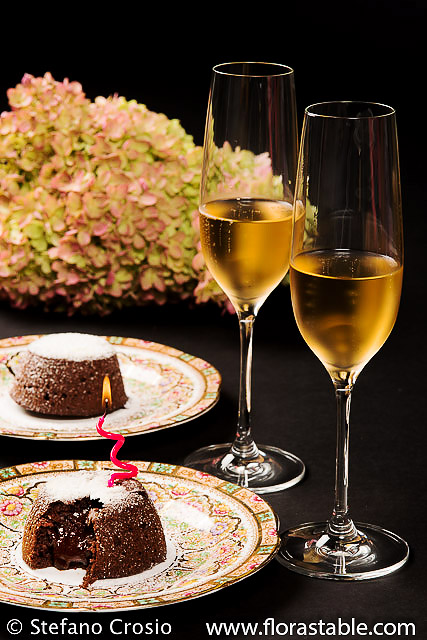
Lava cake and US sparkling wineTime for celebrating: almost in sync with Heather’s beautiful baking blog “Sweet Precision” (happy blog-birthday, Heather!), even Flora’s Table has just turned one year old!

To be precise, F’sT actual birthday should have been October 1 – however, when we were planning the roll out of the blog we screwed up and the first post went actually live on September 30, just minutes before midnight… And now, for consistency, we just thought we would screw up once again by missing the blog’s birthday by three days (or four if you are really into nitpicking…) – what the heck, right?!?

Oh, whatever. We are still celebrating today because it’s been one year something of blogging AND especially because TGIF, which is good reason in itself to celebrate! 🙂

In retrospect, it’s been a fun year, filled with much learning about this blogging thing; exposure to several super-talented people from whose skills and knowledge we have benefitted and learned; enriching exchanges of ideas, perspectives, opinions with so many interesting, stimulating people, near and far; and the blessing of making a few new friends, kindred spirits with whom we have managed to establish a true personal relationship.

This last thing has been incredibly rewarding and worth one year of blogging in and of itself. Yay to that.

We want to take this opportunity to thank each and every one of our wonderful readers, likers, commenters and followers: thank you for being an integral part of a wonderfully diverse, talented and lively community. We are virtually sitting all together around the big communal table chez Flora – just the way we had envisioned the concept behind this blog when we got started.

Just in case you were wondering, in these 12 months the top three food posts (by views) have been:

1. Spaghetti alla Carbonara
2. Spaghetti all’Amatriciana
3. Saffron “Milanese” Risotto

and the top three wine posts (by views) have been:

1. Spaghetti alla Carbonara – Recommended Wine Pairing
2. Wine Review: Oasi degli Angeli, “Kurni” Marche Rosso IGT 2008
3. Chicken and Sausage Paella – Recommended Wine Pairing

To wrap things up, we want to dedicate to all of you a translation into English of a few verses from a song by Italian singer and songwriter Ligabue, which remind us of the interconnection (thank you, Tracy, for coming up with this concept – here’s to you!) and life-blending experience that this year of blogging has been for us:

This is my life
Some days it’s awesome
Some others not so much
It’s the same for all of us
Some days it’s not enough
Some others it feels too much, and instead it never is

This is my life
If you step in, ask me if you may
Take me on a trip
Make me my heart laugh
Bring your own life
So we see what happens if we mix them together a bit

Thank you all, and cheers! 🙂

F&S

Posted in F'sT Home, Uncategorized | Tagged , , , , , | 28 Comments

When Kidlandia meets Foodlandia – Part 2: the Princess and the pea (& ham)

Peas and prosciutto side dishPeas… such a kid-friendly shape veggie and still I have yet to hear a kid say “I love peas!” Who can blame them after all? Have you noticed how these little green fellas are generally served to those innocent tummies? Boiled, maybe with some butter if they get lucky… totally tasteless! I wouldn’t eat them unless I found myself starving on a desert island, so why should children?

What are you saying? Ah! Your kid is a picky eater! Well, let me tell you what I think about picky eaters and please, please don’t take it personally because it’s just my opinion and not the truth about the Holy Grail’s whereabouts. I tend to believe that picky eaters do not really exist: oftentimes it is the parents who do not try hard enough. Ouch, I know!!! Why do I think that? But because I was one of those parents (shame on me)!

During the first three years in my daughter’s life, her majesty didn’t eat anything but milk and fruit. I was feeding her kid’s food (including the contents of those bland, tasteless baby food jars), without putting much effort into it, and she simply refused to swallow it. Every meal was a fight. Every meal was a defeat! Oh gosh! I used to hate meal time!

Then, one day, it just struck me: maybe she wanted something else, maybe she was ready for real, grown-up food. Next thing I remember is me holding a pen and a notepad and calling my mother for my first cooking class ever. That’s how I started, that’s how everything started. 🙂

The recipe I’m sharing today is a classic side dish of the Italian cuisine. Every Italian family has their own recipe. This is how it goes in my house.

Ingredients:

A quarter of a small onion
4 small (or 2 large) slices of ham
1 1/2 Tbsp, butter
1 Tsp, extravirgin olive oil
1/2 pound, peas
1 cup, beef broth
salt

Directions:

Peas and prosciutto side dishChop the onion. Cut the ham into slices and cut the slices into cubes.

In a medium non-stick pot, put 1 Tbsp of butter and pour the oil. Add the chopped onion and cook for about 1 or 2 minutes on a very low heat. Add the ham cubes and keep cooking, stirring often, until the onion cubes soften.

Add the peas, some salt (to taste) and the broth. Keep cooking, stirring often, until the broth completely evaporates and the peas are tender (if the peas are not completely cooked yet after the evaporation of the broth, add some water until the peas get tender).

If you want to make the dish extra moist, once the peas are ready, add a 1/2 Tbsp of butter, toss to coat and serve.

Extra Tip: Although this dish was born as a side dish, sometimes I serve it to her majesty with some pasta. When the peas are almost ready, put a pot of salted water on the stove to boil. When the water is boiling add some pasta (I usually use butterflies) and cook it until al dente. Drain the pasta, put it in the pot with the peas and toss to coat. If you want, you can even dust the top of the dish with some grated parmigiano cheese.

Just give it a try. Who knows? Maybe your picky eater will like this. 🙂

We have a couple of rules that we developed with our daughter during the years that – I think – are worth sharing.

First, we taste a dish at least twice before putting it in the “I don’t like it” category.

Second, since her majesty was able to articulate her thoughts, I have been asking her to explain to me why she doesn’t like a particular dish so that I can change the recipe accordingly. And it usually works!

Of course, these rules are not carved in stone… just a little bit of mom-kid experience that I would like to share out there. Quoting Sid from Ice Age: “Worth a shot”! 😉

Posted in Recipes | Tagged , , , , , , , , , | 28 Comments