

 Francesca and I have recently spent a few days in France, at Saint Emilion, in the heart of one of the most renowned among the Bordeaux wine districts and appellations. There we have enjoyed the courteous hospitality of a fellow blogger (more on that later, on a dedicated post), the culture and the beauty of those places, a lot of good food and wine and of course the magic of the Bordeaux wine country and its multitude of Chateaux.
This post is the first in a series that will take you with us, if only virtually, to visit Saint Emilion and its surroundings and discover some of the attractions that such area has to offer.


We will start by showing you the town of Saint Emilion and telling you something about its rich history on this post, then on future posts we will show you one of its churches, we will talk about the wine country and the Saint Emilion wine classification system, we will take you to a beautiful nearby village and to a full-blown visit of our gracious host’s residence, we will make you visit a lively food market, we will take you food and wine shopping in Saint Emilion, and of course we will visit a few Chateaux and talk about their wines… Yes, it will be a fairly extensive trip, but don’t worry, we will take a break here and there with posts on different subjects, but we think it will be worth your time! 😉


Now, without further ado let’s talk a bit about the town of Saint Emilion.
Saint Emilion is a beautiful, elegant small town located in the Libournais area, on the right bank of the Dordogne River, not far from Bordeaux. Saint Emilion’s long history goes back to the Roman times, and precisely to the IV century when the Roman ruler Decimus Magnus Ausonius (after whom the famous Chateau Ausone, one of the four Premier Grand Cru Classé “A” wineries, was named) erected a property there, where he eventually retired. Incidentally, it was the Romans who got the long-standing Saint Emilion wine tradition started by introducing viticulture to the region.
The beauty of the Saint Emilion landscape and its wine-making history have won the area UNESCO status of World Heritage Site for its being an “outstanding example of an historic vineyard landscape that has survived intact and in activity to the present day”.

Saint Emilion is a town of steep alleys known as “tertres“, winding narrow streets, pleasant squares dotted by bistros as well as several food and wine stores, beautiful Medieval buildings and ancient churches built in the yellowish local limestone, and hectares and hectares of lush vineyards.
Probably the focal point of the town revolves around the central Place de l’Eglise Monolithe: this square borrows its name from the homonymous Monolithic Church, the largest underground church in Europe, that was dug out of Saint Emilion’s limestone rock walls by Benedictine monks between the IX and the XII century. The Monolithic Church’s finely sculpted portal dates back to the XIV century and presents scenes inspired by the Last Judgment and the resurrection.

 Underneath the Monolithic Church lie the Benedictine catacombs and the Hermitage, an underground cave where Saint Emilion himself (an VIII century Benidctine monk called Emilian, who became the town’s patron saint) is believed to have spent the last years of his life, from 750 to 767. There visitors can see an underground spring that was used for baptismal water, a bed and meditation seat both carved in rock, and graffiti reportedly dating back to the French Revolution. Above the Monolithic Church stands an imposing 53 mt/174 ft tall bell tower that was built between the XII and the XV century, while to the side of the church is the XIII century Chapelle de la Trinité (Trinity Chapel) hosting well preserved frescoes on the walls of its apse.

 The inside of the Monolithic Church and the complex comprising the catacombs, the Hermitage and the Trinity Chapel can only be accessed and visited through a guided tour operated by the tourist office and, unfortunately, photography is not permitted anywhere within the complex – so here you will only be able to see images of the outside of the complex.
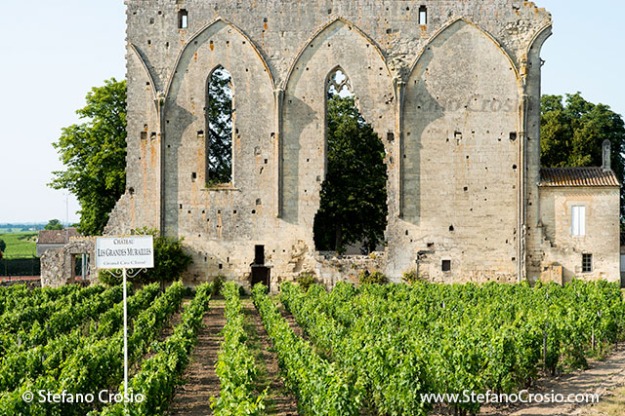
Other notable monuments in Saint Emilion are the Romanesque Eglise Collegiale (Collegiate Church) and its XIV century cloister (this will be the subject of another post), the complex of the Maison de la Cadene and the Porte de la Cadene (House of the Chain and Door of the Chain) located at the top of a steep tertre and dating back to the XVI century, and Les Grandes Murailles (the Big Wall) which are the last remains of what used to be a XIII century Benedictine monastery that collapsed for the most part and are now immersed in the vineyards of the homonymous Chateau Les Grandes Murailles, one of the 63 Grand Cru Classé wineries in the Saint Emilion wine classification.

 Typical of Saint Emilion are also several pastry shops selling two local specialties: the Macarons (delicious almond-based cookies) and the Canelé (small, chewy sweets with a caramelized sugar outside and a core of rum-infused custard).
Enough for today: I hope you enjoyed this first stop in our Saint Emilion trip and our general overview of the town – stay tuned for the next chapters of our chronicle! 🙂








 Flora's Table
Simply beautiful! I love the photography; I feel like you really captured the essence of the country side.
Thank you very much, Elyse: glad you liked it! 🙂
Beautiful pictures, Stefano! Looking forward to the continuation.
Thank you, Anatoli! 🙂
Amazing photos! It’s so beautiful there. Must have been a very nice trip!
Thank you, Sofia: Saint Emilion really is a pretty town immersed in beautiful wine country! Sure worth a visit, if you got a chance.
woo! look at that view!
Isn’t it awesome? Thanks for stopping by, Sarah! 🙂
Lovely pictures! Can’t wait to see more pictures 🙂
Thank you very much: you sure will, be on the lookout for the next chapters! 🙂
Very beautiful pictures!
Thank you, Julian – glad you liked them! 🙂
Stefano, I really enjoyed this virtual trip to Saint Emilion. It’s over a decade since I was last there so it was lovely to see the town again through your beautiful images. I look forward to the next chapter. 😉
Thank you very much, B: I am glad my post brought up nice memories! 🙂
Then next chapter will be coming soon. 🙂
Well, now I have to go to St. Emilion. I’ve only been to Carcassonne in that area, and some villages, but your photos are so beautiful I can’t wait to explore further. Thank you.
Thank you, Chef Mimi: glad you liked the images. I think if you go to Saint Emilion you will not be disappointed in any respect (beauty of the land/town, culture, food, WINE!) 🙂
What a beautiful and vivacious post – it totally triggers the wanderlust yearnings. I can’t wait to read the story of your good blogger friend & out of all the beautiful shots, loved the unexpected jolt of perspective and B&W of the last shot – my favorite- what a cool, fun picture! I’m happy this is a first in a series. Look forward to it.
Thank you very much for your kind words and articulate comment, Azita!
I am glad you enjoyed the read and the images. 🙂 Stay tuned for the post on the beautiful B&B we stayed at that is run by a fellow blogger. His property is quite something!
And thank you for sharing your thoughts on the last shot! I like it a lot too because, just like you said, it is an unusual perspective – sort of like an aerial of a French outside restaurant. 🙂
Absolutely gorgeous. I feel as if I have travelled to St Emilion vicariously through your post.
Thank you very much for your kind words and meaningful comment: it makes me happy because it shows that I accomplished what I was aiming for (taking you on a virtual trip to Saint Emilion)! 🙂
I have just been presented with the gift of a truffle tree in Gascony, I’m hoping to visit my tree one day and when I do I will be sure to pass through St Emilion.
What a historical and beautiful place. I wish if I could visit there someday.
Thank you for your comment! Saint Emilion truly is a beautiful place, one that would not disappoint you and that is well worth the visit.
Les photos sont vraiment magnifiques. Impossible d eviter le moment de nostalgie. Ha la France…
Merci beaucoup pour ton gentils mots, Sylvie. Not sure it is 100% right, but I tried! 😉 I am glad that you liked the images and that they brought up a moment of nostalgia. Yes, France is a beautiful country, plus the food and the wine and… 😉
Che splendide fotografie!
E ch blog particolare, così curato e raffinato, complimenti di cuore e grazie della tua visita al mio blog!
Grazie mille per la visita e per il tuo gentilissimo commento, Miss Fletcher!
In realtà è stata Francesca a visitare il tuo blog: quando me lo ha detto l’ho fatto anch’io ed è davvero bellissimo, tanto che ora ti seguo – complimenti di cuore per una splendida iniziativa!
Un caro saluto
Grazie a te, mi fa davvero piacere che ci siamo trovati!
Pingback: Saint Emilion Chronicles #2: Collegiate Church & Cloisters | Flora's Table
Pingback: Saint Emilion Chronicles #5: Saint Emilion and its Wine Appellations | Flora's Table
Pingback: Saint Emilion Chronicles #6: Chateau de Ferrand, a Visit and a Wine Review | Flora's Table
Ciao! avendo navigato nel vostro blog suppongo di potervi scrivere in Italiano… vi ho scovati girovando qua e là… ho letto la vostra storia, coincidenza n.1 anche io sono nel novero degli italiani all’estero (Canada), e chiaramente mi sono incuriosita, poi quando ho letto pure che siete stati a Saint Emilion recentemente (io ci sono stata 1 mese fa) mi sono di getto iscritta al vostro blog ed ho inviato a scrivere questo commento… complimenti per il blog e per l’idea a monte della condivisione! a presto, Margherita.
Ciao Margherita!
Grazie mille per il tuo commento e per essere entrata in contatto!
Sí, Francesca ed io siamo italiani e viviamo in Connecticut. Tu dove sei in Canada?
Spero che tu sia stata bene a Saint Emilion: a noi è piaciuta sotto tutti i punti di vista.
Il tuo blog è bellissimo ed elegante: complimenti anche per le fotografie che sono di ottima qualitá, per non parlare ovviamente delle ricette che sono interessanti e squisite. Hai fatto un gran bel lavoro.
Ci siamo entrambi iscritti al tuo blog e siamo felici di seguirti nel tuo percorso culinario! 🙂
Ciao e a presto,
Stefano
Pingback: Saint Emilion Chronicles #7, Part I: A Visit to Chateau Figeac | Flora's Table