Of Puppies, Peppers and Potatoes

I want to thank all of you for your words of encouragement about my first steps into puppyhood. I think Chef Mimi is the one that best described what I was about to go through. She said “You are about to experience the worst times in your life, as well as the best times in your life“. She was absolutely right! Only, in my opinion, the worst times outnumber the best times by far!!! 

Let’s not talk about Sofia’s bathroom accidents or the every hour or so that we have to walk her out in this freezing cold weather or the sleep deprivation because she doesn’t sleep through the night. Let’s talk about the chewing and the nipping instead. Just a few descriptive adjectives: constant, unstoppable, devastating. My once lovely and perfect kitchen is a total mess and my once beautiful and spotless hardwood floors are always dirty. Sofia is a bundle of energy that needs constant supervision and training. Every evening, after a seemingly endless day, when she finally falls asleep and I use my last drops of strength to vaguely tidy up my once perfectly organized house, I can’t help but notice a new “gift” left by Sofia’s sharp baby teeth on a piece of furniture. Needless to say, most of the times, it is a piece of furniture that I am particularly attached to because either it is fairly expensive or it took me forever to find. So I go to bed every night with this physical pain in my chest, in a kind of mourning for my cabinet or a chair’s leg, as the case may be, repeating to myself “try not to think about it because Sofia will be up in the blink of an eye”. 

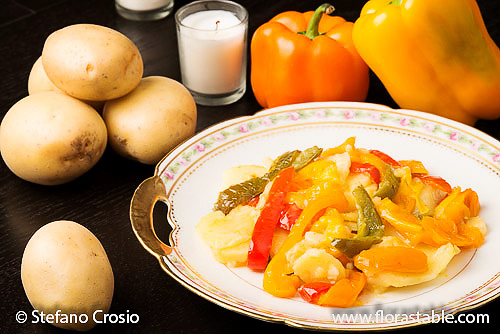
Potato and Pepper Side

When I got pregnant with Her Majesty, I did not read any books about babies and/or motherhood nor did I attend any preparatory class. I entered that hospital labor room thoughtless and clueless. Same thing with Sofia. That sneaky husband of mine did all the puppy reading and disclosed to me only 10% of what he had learned, knowing that, had I been well informed, I would most likely have changed my mind again.

So if I may, let me give a word of advice to anyone of you that is considering getting a puppy: make sure you know exactly what you are getting yourself into. Beside the workload that is required of you which, believe me, is humongous, I have come to the conclusion that your heart must have a special disposition to sacrifice yourself, your time and your things for the sake of the happiness of your puppy. Does my heart have it? The jury is still out on that! 😉

Potato and Pepper SideI guess by now and with the above being said, you have started realizing that cooking has not been one of my priorities lately. I simply cannot afford to devote more than 30 minutes to make a dish. Like this peppers and potatoes side dish. As you may notice, it is a pretty basic one, with only few ingredients. When I want to spice it up, I add some tomatoes and harissa, but I cannot do it when my mom is around because my family recipe does not call for them and my mom does not like when I… “tamper” with her recipes. Once again, the quality of the ingredients is paramount in this dish as there is no seasoning other than salt. 

Ingredients:

1 cup, extravirgin olive oil
5 potatoes
5 peppers
8/9 cherry tomatoes (optional)
1 Tsp, harissa (optional)
Salt 

Directions:

Peel the potatoes and slice them (about 1/4 thick). Cut the peppers into halves and slice them as you would with an apple.

In a large skillet, pour the olive oil, add the potato slices, the pepper slices and some salt (to taste). Cover with a lid and cook, stirring occasionally, for about 10/15 minutes. Add the tomatoes and the harissa and keep cooking for another 10/15 minutes, stirring occasionally. 

Et voila! Ready by the time of one of Sofia’s naps! 

I wish you all a super fun and relaxing Super Bowl weekend! 

Posted in Recipes | Tagged , , , , , , , , , , , , , , , | 20 Comments

WinEvents: Vinitaly International/Slow Wine NYC 2014 & Gambero Rosso’s Tre Bicchieri NYC 2014

Just a quick FYI to let our US-based readers know that, once again, the time has come for the two most important Italian wine fairs in the US: both Vinitaly International in association with Slow Wine 2014 and Gambero Rosso’s Tre Bicchieri US Tour 2014 are upon us.

VinItaly International 2014 - NYC

SlowWine 2014 - NYC

Vinitaly International/Slow Wine 2014 will take place in New York City on February 3, 2014 from 9:30am to 5:00pm at the Metropolitan Pavilion, 125 W 18th Street. Registration is limited to members of media and trade and is available on the Vinitaly International Website, along with the program of the event itself and that of the master classes.

Are you curious how the event was after all? Check out our post with the full coverage of the Vinitaly International/Slow Wine NYC 2014!

Should you wish to read my summary of Vinitaly International/Slow Wine 2013, please check out my post from last year.

Gambero Rosso - Tre Bicchieri World Tour 2014 - NYC

Gambero Rosso’s Tre Bicchieri US Tour 2014 will be in New York City on February 6, 2013 from 2:00pm to 6:00pm at the same venue as Vinitaly International/Slow Wine 2014, the Metropolitan Pavilion, 125 W 18th Street. Even here, registration is limited to members of media and trade: more information is available on Gambero Rosso’s Website.

Are you also curious about how this event turned out to be? Check out our post with the full coverage of Gambero Rosso’s Tre Bicchieri NYC 2014!

Should you wish to read my summary of Gambero Rosso’s Tre Bicchieri US Tour 2013 – NYC, please check out my post from last year.

I will be attending both events with Talk-A-Vino’s Anatoli (as I did last year) and this year we will be joined for the Vinitaly International/Slow wine event by The Winegetter’s Oliver! Should any of you plan on participating, please drop me a line in the comments section: it would be fun if we could get together!

Posted in Wine, Winevents | Tagged , , , , , , , , , , , | 8 Comments

Wine Review: Planeta, Chardonnay Sicilia IGT 2009

Planeta ChardonnayToday’s review is of a Sicilian Chardonnay made by excellent Sicilian winemakers Planeta from whom we have previously reviewed their outstanding Nero d’Avola “Santa Cecilia” and their Syrah – specifically, today we are going to review PlanetaChardonnay Sicilia IGT 2009 ($35).

Will it be in the same league as their wonderful reds? Keep reading and let’s find out together! 🙂

The Bottom Line

Overall: What can I say… a spectacular wine and excellent value for money! A wonderful golden color, a sensuous, complex, multi-layered bouquet that strikes a perfect balance between fruity secondary aromas and delicate tertiary aromas, luscious on the palate with a kaleidoscope of delicious flavors; acidic, tasty and super long. This is a wine that should be tasted by those who are skeptical about Italian whites in general or about Chardonnay’s potential in warmer climates such as Sicily. Oh Man… This is a wine with the “wow” factor!

Rating: Spectacular and, needless to say, wholeheartedly Recommended! Spectacular – $$

(Explanation of our Rating and Pricing Systems)

About the Grape

Chardonnay is a white-berried variety that is indigenous to the French area between Lyon and Dijon, encompassing Burgundy and Champagne. The earliest documented mention of Chardonnay dates back to the late XVII century in the village of Saint Sorlin (today known as La Roche Vineuse) under the name “Chardonnet“, although the variety takes its name from the village of Chardonnay near the town of Uchizy in southern Burgundy.

DNA analysis showed that Chardonnay is a natural cross between Pinot and Gouais Blanc.

Chardonnay Rose is a color mutation of Chardonnay, while Chardonnay Musque’ is a mutation with Muscat-like aromas.

Chardonnay is one of the most versatile and adaptable white grape varieties, which explains in part why it has been so extensively grown all over the world. Chardonnay grapes are generally high in sugar levels and do not have a dominant flavor of their own, so the wines made out of them tend to take on a variety of aromas depending on where the grapes are grown and how the wines are made. Thus Chardonnays run the gamut from subtle and savory to rich and spicy still wines as well as being one of the base wines for Champagne and other Classic Method sparkling wines.

Chardonnay is a typical international variety given how widely it is cultivated on a worldwide basis, from native France, to Italy, North and South America and Australia.

(Information on the grape variety taken from Wine Grapes, by Robinson-Harding-Vouillamoz, Allen Lane 2012 – for more information about grape varieties in general, check out our Grape Variety Archive)

About the Estate

Planeta’s Chardonnay is made out of grapes coming from the 51 HA Ulmo vineyard and the 42 HA Maroccoli vineyard (the latter situated at 1,475 ft/450 mt above sea level) within Planeta’s Ulmo estate, located near the town of Sambuca di Sicilia (Agrigento), on the western coast of Sicily. The density of the Chardonnay vines in the two vineyards is between 3,800 and 4,500 vines/HA.

Ulmo is the first and the oldest among Planeta’s current estates: it became operational in 1995, along with its winery, and it encompasses 93 HA of vineyards where Chardonnay, Merlot, Grecanico, Nero d’Avola and Syrah are grown to make certain of the wines in the Planeta lineup, including their Chardonnay “supercru“.

Our Detailed Review

The Planeta, Chardonnay Sicilia IGT 2009 that I had was 13.5% ABV and retails in the US for about $35.

The wine was made from 100% Chardonnay grapes grown in Planeta’s Ulmo and Maroccoli vineyards (on which, see above for more information). It fermented for 15 days in French oak barrique barrels (50% new and 50% previously used ones) with the addition of selected yeasts.

As usual, for my review I will use a simplified version of the ISA wine tasting protocol that we described in a previous post: should you have doubts as to any of the terms used below please refer to that post for a refresher.

In the glass, it poured a rich, golden color, thick when swirled.

On the nose, it was intense, delectably complex and excellent, with aromas of banana, melon, grapefruit, lemon, peach, hints of herbs (rosemary), hazelnut and minerals.

In the mouth, the wine was dry, warm, smooth; fresh and tasty. It was full-bodied and masterfully balanced, with intense and excellent mouth flavors of peach, lemon, almond, minerals, herbs and hints of acacia honey. Its finish was exquisitely long and its evolutionary state was ready (i.e., wonderful to enjoy now, but it might be even better, more complex if it rests one or two more years in your cellar).

Posted in White Wines, Wine, Wine Reviews | Tagged , , , , , , , , | 12 Comments

Saint Emilion Chronicles #6: Chateau de Ferrand, a Visit and a Wine Review

The wine tasting area of Chateau de Ferrand (Grand Cru Classé)

After a hiatus due to the winter holidays and the addition of cyclone Sofia 😉 to our family, it is time to resume our Saint Emilion series.

Today we will briefly talk about one of the Chateaux that we visited during our stay, namely Chateau de Ferrand, and I will review their Grand Vin, of which I brought a couple bottles home.

On a previous post, we have provided a general overview of the Saint Emilion wine region and its wine classification system: if necessary, take a look at it for a refresher.

Chateau de Ferrand (Grand Cru Classé)

About the Producer and the Estate

Chateau de Ferrand is located near the town of Saint Emilion, on the right bank of the Dordogne river, not far from Bordeaux. The Chateau was founded in 1702 and since then it was remarkably owned by only two families: that of Elie de Bétoulaud, the founder, and since the XX century that of Baron Marcel Bich, the man who became world-famous for the inexpensive, disposable ballpoint pens which still bear an abbreviated version of his name, “Bic“.

The wine case storage area at Chateau de Ferrand (Grand Cru Classé)

Incidentally, there are two interesting anecdotes regarding the Baron and the abbreviation of his name: (i) Baron Bich was actually Italian – he was born in 1914 in Turin and relocated to France when he was in his thirties and (ii) the decision to drop the “h” at the end of his name in the pen brand was reportedly due to commercial reasons, namely the concern of how the word “Bich” could sound when pronounced by English-speaking consumers… 😉

Nowadays, Chateau de Ferrand is managed by Pauline Bich Chandon-Moët, a descendant of Baron Marcel Bich who married Philippe Chandon-Moët, whom we have been fortunate enough to meet and chat a little bit with in the course of our visit.


The vineyards of Chateau de Ferrand (Grand Cru Classé)

The estate counts 32 HA of vineyards where Merlot is the dominating variety (75%), as is generally the case in Saint Emilion, followed by Cabernet Franc (15%) and Cabernet Sauvignon (10%). The estate lies on a limestone plateau with clay-rich soils where the vines are planted at altitudes ranging from 150 to 330 ft (46 to 100 mt) above sea level. The average density reaches an impressive 7,000 vines/HA and the Chateau’s annual production is about 180,000 bottles.

Ripening Merlot grapes at the vineyards of Chateau de Ferrand (Grand Cru Classé)About the Grapes

You can find out many cool facts about and the DNA profiling of Merlot, Cabernet Franc and Cabernet Sauvignon by checking out our Grape Variety Archive.

About the Wine

Chateau de Ferrand is a Saint Emilion Grand Cru Classé wine: it was promoted to the status of Grand Cru Classé in the 2012 revision of the classification of the wines of Saint Emilion (for more information, see our previous post about it). It is made as a Bordeaux blend of the three varieties that grow in the estate. Although the percentages in the blend vary from vintage to vintage, by and large they are similar to those of the plantings that we mentioned above.

Interestingly, in the winemaking process, Chateau de Ferrand’s enologist uses a cutting-edge Italian-made destemmer and optical grape sorting machine called X-Tri to automatically sort the grapes worthy of their Grand Vin from those that are not up to standard. Should you wish to know more about this unbelievable machine (it can accurately sort about 15 tons of grapes per hour!), check out the producer’s website, which also includes a pretty cool video demonstrating how it works.


The X-Tri optical grape sorter of Chateau de Ferrand (Grand Cru Classé)

The must then goes through a short 2-day pre-fermentative cold maceration phase to maximize the extraction of color and aromas, followed by approximately 10 days of fermentation with natural yeast in concrete vats and then full malolactic fermentation that is started naturally, by increasing the wine’s temperature (without adding any lactic acid bacteria).

Concrete fermentation tanks at Chateau de Ferrand (Grand Cru Classé)

Finally, the wine ages for about 15-16 months in 60% new oak barrique barrels and 40% one-time used barriques (these are mostly French oak, with about 10% of US oak) plus 24 more months of in-bottle aging.


The barrique cellar at Chateau de Ferrand (Grand Cru Classé)

Our Review

Based on my tasting of several vintages of the Grand Vin at the end of the visit (there is also a Second Vin called Le Différent de Châteaux de Ferrand), I decided that I liked 1999 the best, so that is the wine we are going to review today.

Hydraulic presses at Chateau de Ferrand (Grand Cru Classé)

As always, for my review I will use a simplified version of the ISA wine tasting protocol that we described in a previous post: should you have doubts as to any of the terms used below please refer to that post for a refresher.

Chateau de Ferrand, Saint Emilion Grand Cru AOC, 1999 ($35)


The wine tasting area of Chateau de Ferrand (Grand Cru Classé) with their resident sommelierThe wine was 13% ABV and the proportions of the blend were 83% Merlot, 14% Cabernet Franc and 3% Cabernet Sauvignon. In the U.S. it retails for about $35, while in France it retailed for €50. I decanted it for an hour before enjoying it.

In the glass, the wine was ruby red and viscous when swirled.

On the nose, its bouquet was intense and fine, although not particularly complex, with aromas of cherry, cocoa and black pepper.

In the mouth, the wine was dry, with medium ABV, silky smooth; still moderately acidic, with velvety tannins and tasty; it was medium-bodied and wonderfully balanced, with intense and fine mouth flavors of cherry, raspberry, licorice and dark chocolate. It had a long finish and its evolutionary state was mature, meaning to be enjoyed now as it will likely start declining if left to age longer.

Overall, the Chateau de Ferrand 1999 was a very good wine: despite its aromas being not particularly complex, the wine really won me over once it was in my mouth.  After 14 years of aging, its mouth flavors were still lively and elegant and the wine was perfectly integrated and cohesive, silky smooth and gently tannic, with still enough acidity to keep it alive and kicking – not for much longer though, so should you have a bottle in your cellar, I suggest you find a good reason to enjoy it now!

Rating: Very Good and Recommended Very Good – $$

(Explanation of our Rating and Pricing Systems)


The vineyards of Chateau de Ferrand (Grand Cru Classé)

Posted in Red Wines, Wine, Wine Reviews | Tagged , , , , , , , , , , , , , , | 10 Comments

MWWC#6 – Two Wines, Three Mysteries

MWWC-logoRight before the winter holidays, creative fellow wine blogger Jeff (AKA The Drunken Cyclist) launched a fun initiative: a wine-based Secret Santa that he aptly renamed Secret Alcoholic. Basically, Jeff’s wife kindly took care of pairing each participant with a buddy Secret Alcoholic to whom one or two surprise bottles of wine could be shipped.

This, coupled with another recent brainchild of Jeff’s, a monthly theme-based wine writing challenge, gave me the opportunity to (so to speak) “break two wine glasses with one stone”: this post will be my first entry to wine writing challenge #6 (theme: Mystery) but will also serve the purpose of acknowledging my Secret Santa and sharing my tasting notes of the wines that I received.

Let’s cut to the chase without further ado: I mentioned in the title that there would be three mysteries to be solved – these are:

1. Who was my Secret Santa?

2. Which wines was she kind enough to send my way?

3. What did they taste like?

These three gripping mysteries worthy of Huckle Cat were all solved by the beginning of the New Year…

Right before Christmas, I received my package which, much to my 7 year old daughter’s delight, was nicely decorated with festive stickers, which led her to claim that the package “had to be” for her… 😉 After redirecting her to more age-appropriate presents, I opened the box and found a holiday card that solved mystery number 1: my Secret Santa was witty and ever pleasant to read Kirsten, AKA The Armchair Sommelier!

In a matter of seconds was mystery number 2 also solved: thoughtful and generous Kirsten had sent me two wines: a Viognier from her own State, Virginia, and one of her favorite Californian Syrahs, which is also a hard-to-get, wine-club-only red that has received some very positive attention from wine critics.

I very much appreciated the thought she put into selecting those wines: not only for her generosity in parting from and sharing with me a bottle of that exclusive Syrah, but also because she chose that Viognier to introduce me to one of the best expressions of that variety in Kirsten’s own State. I am all for promoting quality wines made from locally grown grapes, especially if they come from wine regions that are not as well known to the general public as others that enjoy widespread repute. So, way to go, Kirsten – I bow to you!

With Kirsten’s bottles in hand, solving mystery number 3 was only a question of waiting a few days before opening them and tasting their contents – just to make sure that they would recover from any bottle shock.

As is always the case for me with any wine, this was the most exciting mystery to unveil. Because no matter how well you may know a wine’s grape variety, the region it comes from, its environmental conditions, the producer or even previous vintages of that same wine, no matter all that, you may sure make your own educated guess about what to expect from it, but in the end you will always have to taste that specific bottle to appreciate all its subtle nuances.

To put it in the succinctly eloquent prose of fellow wine blogger Julia Bailey, who has devoted her own entry to this month’s wine writing challenge to this very topic: “It is simply impossible to know exactly what your wine will taste like until you pop that cork.” So true: if you want to learn more, I definitely suggest that you read Julia’s entry wherein she elaborates on several reasons why this is so.

As for me, time to wrap things up by sharing my tasting notes of the two wines. My tastings have been conducted in accordance with the ISA wine tasting protocol, but for brevity here I will not go through the entire step-by-step tasting process: I will only summarize the main characteristics of the wines and of course provide my own assessment.

Check out our Grape Variety Archive for cool facts about the Viognier and Syrah grape varieties, including their DNA analysis which suggests that they are relatives!

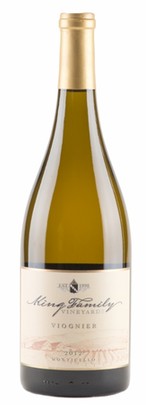
1. King Family Vineyards, Viognier Monticello 2012 (13% ABV – $22)

King Family Vineyards, Viognier Monticello 2012In the glass, it poured a nice straw yellow and was moderately viscous when swirled.

On the nose, it offered intense and pleasant aromas of yellow peach, apricot, pineapple, white flowers and hints of white pepper (a tertiary aroma suggesting some gentle oak aging).

In the mouth, the wine was smooth and exhibited only moderate acidity, which suggests that this wine should be enjoyed now. It was balanced and medium-bodied, with intense mouth flavors that matched the aromatic pattern perceived on the nose, and had a medium finish.

Overall, a good white with a nice bouquet and fruity mouth flavors, ending up in an intriguing, slight peppery finish. Not extraordinarily complex, but definitely pleasant.

Rating: Good Good – $$

(Explanation of our Rating and Pricing Systems)

2. Herman Story, Syrah “Nuts & Bolts” California 2009 (16% ABV – $45)

Herman Story, Syrah "Nuts & Bolts" California 2009In the glass, it poured ruby red and viscous when swirled.

On the nose, it released an impressive array of intense and complex aromas of blackberry jam, wild berries, black cherry, tobacco, ground coffee, black pepper and licorice. A great bouquet that anticipated the “blackness” of this wine.

In the mouth, it immediately struck as a big, chewy, fruit-forward wine: its very high ABV (which nears the limits of alcoholic fermentation and pushes this wine to the highest step in the ISA scale of ABV perception: alcoholic) was tough for the wine’s good acidity and solid but unobtrusive tannins to counterbalance, also due to the wine’s not particularly high smoothness (I wonder whether it did full malolactic fermentation). This high ABV perception, that is clearly evident on the top of the palate, throws the wine a bit out of balance: given its good acidity, I would let it rest for two or three more years and then re-taste it.

The wine was full-bodied, exhibiting intense mouth flavors of blackberry, black cherry, plum, coffee, tobacco, dark chocolate, licorice and black pepper, which closely trailed the wine’s aromatic palette, and it had a medium to long finish.

Overall, I found the Nuts & Bolt somewhat of a “double-faced” wine: on the one hand, it had great, complex and intense bouquet and (if a little over the top) mouth flavors, but on the other hand, its very high alcohol (which its other qualities did not seem to effectively counter, at least at this stage of its life) made the wine feel a bit imbalanced. A few more years of aging may help make this wine more graceful.

Rating: Good (especially in perspective) Good – $$$

(Explanation of our Rating and Pricing Systems)

Posted in Red Wines, White Wines, Wine, Wine Reviews | Tagged , , , , , , , , , , , , , , , | 19 Comments

A little furry addition to Flora’s Table Home

Hello Everyone!

I decided to barge into your houses on this lazy Sunday late afternoon to share some… news (I don’t even know which adjective I should be using here! I guess for lots of you, it would be “great”).

As you may know, I’m not a people person. I love to spend time with myself, I like to keep to myself and I’m very, seriously – very bad at small talk. To make you like me even more 😉 let me add that I’m not an animal person either. I have never wanted a pet when I was a child and I have never dreamed of taking care of any living being who is unable to go to the restroom and flush the toilet.

Needless to say, the idea of having a dog never even crossed my mind until… did you notice that kids almost invariably so to speak reshuffle the cards in their parents’ lives? 😉

When I got pregnant with her majesty, Stefano came up with the “brilliant idea” to get a puppy so her majesty and the puppy could grow up together. Only a man could come up with such a cute and, at the same time, dumb idea!!! So of course I ruled that out right away…

Since then, I have been dodging the “puppy bullet” for seven years! Seven wonderful pet-free years! I could always come up with a different reason not to have a dog: her majesty was too little, we didn’t have a yard, we were about to change home and city and it wasn’t the right moment. I was pretty sure that sooner or later they would get tired of asking and forget all about this idea and I would be saved forever. I couldn’t be more wrong! Those two just kept conspiring, regrouping and changing their battle strategy.

Stefano is well aware that sleeping is – by far – my favorite activity. My bed is my reign and my heaven and, for me, there is no other place like that. One late morning this past fall, I was still sleeping (of course!) when my daughter, pushed by my sneaky husband, asked me for the countless time if she could have a dog.

In that specific moment, I made an unforgivable mistake. I said “maybe”! The battle was over and lost for good because they hung on that maybe which eventually turned into a “yes” in the next couple of weeks. Next thing I know I was in the car with the two conspirators to go check a few breeders out across New York State and Connecticut.

To make a long story short, our “English type” chocolate labrador puppy, that her majesty decided to name Sofia, set her paws in our house on December 16, turning our house and our lives into complete chaos.

To sum it up, Stefano and her majesty are over the moon, my dad (who is a dog lover) is very happy, my mother is complaining and driving everybody crazy every time Sofia has a “bathroom” accident in the house and… as for me? I have never been big in the feelings department and it takes me a very long time and quite some effort to express them so, for now, I only feel like conceding that she is one of the cutest thing I have ever seen, isn’t she?

Well, please wish me luck and stay tuned! 😉

Francesca Xx

PS: Thank you very much for all those who checked in to make sure we were alright as a result of winter storm Hercules: we definitely are and honestly it has not been that bad where we live – we got about one foot of snow (much to Sofia’s delight!) and the temperatures dropped to 1 F (or -18 C!) but we have been coping just fine! 🙂

Posted in F'sT Home | Tagged , , , , , , , , , | 50 Comments

Celebrating The New Year Deliciously: Sartu’ di Riso

Rice Sartu'

If you are a regular reader of this blog, you know that I love simple and quick recipes. Like most of you, I don’t have much time to spend in the kitchen just for the pleasure of it, especially on a week day, so I tend to opt for dishes that can be ready in a couple of hours.

Of course there are exceptional times and the holidays are one of them. First of all, I am always (well let’s say often!) in a very good mood because I love Christmas time. There is something magic about it and it seems to affect my way of being in a positive way! 😉

Second of all, my parents are always visiting us and when they are in our house, I feel this strong urge to eat dishes whose flavors bring up childhood memories. I’m sure many of you have experienced the same feeling when mommy is around. You automatically return to play the child’s role as if no years had gone by since you were a little kid (although in the meantime you may have become a parent yourself!) and spent time in the kitchen watching your mom prepare some delicious food.

Last but not least, having my parents in the kitchen equals four additional hands capable of working in harmony, without supervision, tremendously shortening the cooking time and, most importantly, delivering spectacular results, no matter what. I could not ask for more! 🙂

Well, after some thought, I have settled on the well known Neapolitan “sartu’ di riso” or rice sartu’ as my dish of choice to celebrate the arrival of the New Year.

Let me tell you about the way this great dish was born according to a story that I recently read on an Italian website, which amused me so much that I think it is worth sharing.

Rice Sartu'According to this story, rice first arrived in Naples from Spain at the end of the 14th century, along with the Aragonese domination.  Unfortunately for those little grains, people from Naples did not like them at all! Apparently, they associated rice with the food given to people sick with gastrointestinal diseases (boiled white rice). For this reason, Neapolitans started calling rice “belly washer”! 🙂 🙂 🙂

According to the story, rice migrated to more welcoming lands, i.e., to the North of Italy where it was received with all the honors and decided to make itself at home there, thus starting a long-standing tradition of delicious risotto dishes. 🙂

Four long centuries had to go by before rice would come back to the Neapolitan soil and finally get the attention and credit it deserves. In the 18th century, Naples was under French domination and the Neapolitan aristocratic families really wanted to fit in and looked sophisticated before the eyes of the new rulers, so they started speaking French and eating French food. So, the kitchens of Neapolitan aristocrats became the reign of French cooks and those Neapolitan cooks who knew how to cook French food.

Now, the French happened to love rice, so the cooks had to find a way to make the Neapolitan nobles like rice, one way or another. The first thing they did was to add some tomato sauce (so beloved by the Campanian palates) to the rice. But that wasn’t enough! So they decided to also add peas, fried eggplants and small meatballs to the rice to enrich its taste. Those sneaky cooks came up with the idea of putting all these yummy “treats” on top of the rice as a garnishment to make the nobles’ mouths water. The French translation of “on top of everything” is “sur tout“. The passage from the French “sur tout” to the Neapolitan adaptation “sartu’” was just a short step! 😉

Every food story has and should have a happy ending. This one is no exception. The Neapolitan aristocrats ended up loving sartu’ very much and, little by little, this amazing dish found its way to the tables of those who were not as privileged, proving that good food doesn’t know social stratification! 😉

Before we get to the actual recipe, let me just clarify one point. Both my parents are from the South of Italy but neither of them is from Naples. Thus, the recipe that I’m about to share is my family’s version of sartu’. I have read and seen many versions of this dish and I noticed that most of them use the so-called Neapolitan ragu’ (a meat-based tomato sauce that is made, among other ingredients, with ground meat and sausages) as the assembling sauce of the sartu’ as opposed to my family’s version which calls for simple tomato sauce. As to the filling and the garnishment, I have seen sausages, eggplants, mushrooms, chicken livers and even pancetta. As cheese, some use some provolone cheese in lieu of mozzarella cheese.

What I’m trying to say is twofold: firstly,  our recipe can be just a starting point for you to come up with your own family version of sartu’, being creative and using the ingredients that you and your loved ones like the most.

Secondly, if there is some of you, beloved readers, who comes from Naples (or whose family comes from there) and is willing to share their thoughts and family traditions about this rice masterpiece, I would love to hear from you!

And now, without further ado, let’s get a little technical! 😉

Rice Sartu'

Ingredients: 

1 pound, Arborio rice

For the tomato sauce:

3/4 of 1 cup, extravirgin olive oil
1/2 yellow onion, finely chopped (optional)
2 cans, San Marzano peeled tomatoes
3/4 pound, green peas
Salt

For the meatballs and tomato sauce: 

1 pound, ground beef
3 slices, white bread
3/4 Tbsp, whole milk
8 Tbsp, grated Parmigiano cheese
3 eggs
2 cups, vegetable oil
1/4 cup, extravirgin olive oil
1/4 yellow onion, finely chopped
1 can, San Marzano peeled tomatoes
Salt

For the filling and assembling:

10 mozzarella ciliegine
4 hard boiled eggs
8 Tbsp, grated Parmigiano cheese

Directions:

Take the mozzarella ciliegine out of the water and put them in a colander until it’s time to use them for the filling so that they will lose their excess water.

Put the bread slices into the milk. If you don’t have milk, you can use some water instead.

In a non-stick large pot, pour the oil and, if you decide so, the onion (my mother doesn’t use it 🙂 ) and cook, on a very low heat, until the onion softens.

Place a food mill directly on top of a pot and process the tomatoes, add some salt (to taste) and let the sauce cook in the pot on medium heat. After about 15 minutes, add the peas. Keep cooking, stirring occasionally, until the water evaporates completely and the sauce thickens.

While the first sauce is cooking, put the ground meat into a bowl. Squeeze the bread with your hands and add it to the meat. Add the Parmigiano cheese, the eggs, some salt (to taste) and knead the meat mixture with your hands until you obtain a smooth and homogeneous mixture. With the help of your hands, make small meatballs. Their size should be that of half a walnut.

Pour the vegetable oil into a non-stick medium/large pot on medium heat and when the oil is hot, fry the meatballs. Put the fried meatballs in some paper towel so that the paper absorbs the excess oil.

Pour the olive oil into another non-stick pot, add the onion and cook, on a very low heat, until the onion softens. Always with the help of a food mill, process the tomatoes, put them into the pot, add some salt (to taste) and let the sauce cook on medium heat. After about 20 minutes, add the fried meatballs. Keep cooking, stirring occasionally, until the water evaporates completely and the sauce thickens.

Put a large pot of salted water on the stove to boil.  When the water is boiling, add the rice and cook until al dente, stirring occasionally. Drain the rice, add the peas, tomato sauce and 5/6 Tbsp of Parmigiano cheese and, with the help of a wooden spoon, toss to coat.

In a bundt cake pan, put some of the rice mixture up to half the height of the pan. Cut the mozzarella ciliegine in half and distribute them evenly on top of the rice mixture. Cut the hard boiled eggs into bits and add them on top of the rice and the ciliegine. With the help of a paddle, repeat the same process with some of the meatballs. Cover the ciliegine, the eggs and the meatballs with the rest of the rice. Finish up by adding the rest of the Parmigiano cheese as well as some tomato sauce with a few meatballs.

Preheat the oven at 350 F. Put the sartu’ in the oven for about 30 minutes. Let it cool off completely and turn the sartu’ over on a serving plate.

I usually put the rest of the tomato sauce and meatballs in the hole in the middle of the sartu’. Unfortunately, I did not have enough meatballs left to decorate the top of my sartu’ because Stefano was famished and ate lots of meatballs which were supposed to be used as garnishment. 😉 Hopefully, your equivalent of him is not going to be around when you are about to put the finishing touches on your dish! 😉 You can even use some slices of hard boiled eggs as final garnishment.

A little note as a final touch. My pan worked beautifully and it was very easy to turn my sartu’ over once it cooled off. I have read that, if you are not completely sure about your pan, you can grease it with some butter and cover it with breadcrumbs. I haven’t tried this method yet so I cannot vouch for it but my mom tells me that it works wonderfully. 🙂

Well, this was sure long, but hopefully worth it! 🙂 Please let me know if any of you decides to give it a shot and try it out!

May you all have a smashing, wonderful and delicious New Year! 🙂 🙂 🙂

Posted in Recipes | Tagged , , , , , , , , , | 46 Comments

Happy Holidays!

Happy Holidays!

Just a quick note from the both of us to wish you all Happy Holidays and a wonderful, peaceful and rewarding  New Year! 🙂

Posted in F'sT Home, Uncategorized | Tagged , , , , , , | 36 Comments

Meet the Maker: Valtellina’s Nebbiolo – An Interview with Ar.Pe.Pe.’s Enologist

On previous posts, we have presented the Italian wine district of Valtellina and introduced one of the finest Valtellina wine producers, Ar.Pe.Pe. along with a tasting of their wines.

On this post, which concludes our mini-series about Valtellina, you can find an interview that Ar.Pe.Pe.’s enologist and co-owner Isabella Pellizzatti Perego was kind enough to do with me.

Ar.Pe.Pe.'s enologist and co-owner in their stunning tasting room

Here are the questions I asked Isabella, along with a summary of her answers – let me give you heads up about the fact that some of the discussion is fairly technical in nature, but at the same time I think it is very interesting and educational:

Q1. First of all, would you care to explain the logic behind the various labels in your lineup and their release to the market? I understand they are not all available every year, so maybe you can elaborate a little bit on that?

A1. Certainly: essentially, we are pretty black and white with our production – let me try to explain.

At the top of our range there are the following four Crus or Riservas: Grumello Buon Consiglio; Sassella Rocce Rosse; Sassella Vigna Regina; and Sassella Ultimi Raggi.

These current Crus will soon be complemented by two new Crus that we have started making since the 2009 vintage and that are currently at the beginning of their aging phase. These new wines will be released to the market in 2018: one is our first Riserva from our vineyard in the Inferno subzone and the other one is a new Riserva from our Grumello vineyards that is going to complement our Buon Consiglio Cru.


Ar.Pe.Pe.'s 5.5 HL wood tonneau aging casks

Beside those, we have the Inferno Fiamme Antiche which, so far, is the only label that we make from our vineyard in the Inferno subzone. When our new Inferno Cru becomes available, the Inferno Fiamme Antiche will be its second vin.

Finally, there is our entry-level, easy and ready to drink wine known as Rosso di Valtellina.

Now, the Rosso di Valtellina is the only one of our wines that is available every year.

Instead, our concept for our premium wines is that, depending on our assessment as to the quality of the grapes we harvest, we decide whether they are worthy of a Cru or they should be “downgraded” to second vin. We do not compromise: the entire crop for each subzone either becomes a Cru or a second vin.

So, for instance, if one year you see that we release the Grumello Buon Consiglio Riserva, that means that for that year the Grumello Rocca De Piro will not be released, and vice versa, which of course entails a significant sacrifice in terms of revenues. But we are happy this way: we want to stand behind the quality and reputation of our wines and we do not take any shortcut to do so.
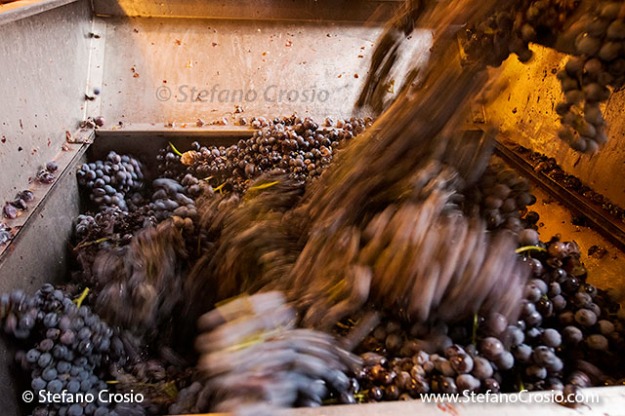
Mountain Nebbiolo grapes in Ar.Pe.Pe.'s destemmer

Q2. The mountain Nebbiolo of Valtellina has been recognized as a biotype that is geographically distinct from Piemonte’s Nebbiolo and several clones have been identified. Can you tell us something about the clonal choices that you made in your vineyards?

A2. Valtellina’s Nebbiolo presents greater biodiversity in its clones compared to Piemonte’s Langhe Nebbiolo (where the three main clones are Michet, Lampia and Rosé). In Valtellina at least 10 different clones have been identified. For our vineyards, we have selected a mix of the various clones and we are observing how each of them has adapted to our terroir and how it performs. This way, we can identify the vines that perform best and then use those same clones to add new vines or replace existing ones.

Q3. Let’s talk a little bit about viticulture: what’s the average density and age of your vineyards? Are your vines all grafted? Which month of the year do you harvest and is it all done by hand?

Helicopter carrying Nino Negri's harvested mountain Nebbiolo grapes

A3. Our average density is 5,500/6,000 vines/HA and on average our vines are 50 years old – most are grafted, but there still are a few plants that are ungrafted.

We harvest exclusively by hand due to the characteristics of our territory, which prevent the use of anything mechanical. It is pretty much the same for all of the Valtellina producers, although some (such as Nino Negri) go as far as using helicopters to carry the crates with the harvested grapes as fast as possible to the winery. In general, we harvest the grapes for all our wines in the second half of October, except only those for our Ultimi Raggi Cru (which is our late-harvest wine) which get picked in the second half of November, just before the first snow of the season.

Q4. Speaking of the Ultimi Raggi: this is a wine that falls within the Valtellina Superiore Riserva DOCG appellation (subzone Sassella). Since it is a dry raisin wine, can it be considered your own take of a Sforzato della Valtellina? Why does it not fall within that separate DOCG?

A4. Well, yes and no: our Ultimi Raggi is a late-harvest dry raisin wine like a Sforzato, but it cannot be classified as such as the regulations for the Sforzato della Valtellina DOCG appellation require that the grapes be picked during the regular harvest season and then be dried on straw mats (in other words, it is not a late-harvest wine).

Instead, with the Ultimi Raggi we have made the choice of drying the grapes while they are still on the vine, by picking them generally a month later than the regular harvest. It is a riskier choice, because a few years ago we had just finished harvesting the last vines for the Ultimi Raggi when it started snowing: had it happened one day earlier, a large part of our harvest would have been lost. So, it is a riskier choice, but we feel that it really pays off in terms of the quality of the wine that we make.

Q5. How do you feel about organic viticulture? Is it something you are considering embracing?

A5. We practice an integrated approach to viticulture, which imposes very restrictive practices already. We would love to go all the way to organic, but considering our geography, that is made of steep mountain slopes and makes it impossible for us to mechanize anything, currently we are not in a position to incur even greater labor costs. Just think that the integrated viticulture approach that we practice results in 1,300 working hours per year for each hectare of vineyards: more than twice the number of man hours that are required in Piemonte’s Langhe and about three times as many as those required to harvest hill vineyards in general.


Delastage "rack and return" process of Ar.Pe.Pe.'s fermenting must

Q6. Let’s move on to your ultra-conservative winemaking choices: what kind of vats do you use to ferment your wines? Also, do your wines do malolactic fermentation? And for both fermentations, do you use selected yeasts and acid bacteria or are both fermentations spontaneous?

A6. We still use 50 HL wood barrels to ferment our wines: we have them made using the same traditional, proprietary mix of oak, chestnut and acacia that we use for our aging barrels. Then, after each fermentation, we gently scrape the inside of the barrels to remove any possible residue. It is a lot of work compared to just using stainless steel vats, but we think it is worthwhile because of the additional flavor and smoothness it contributes to our wines.

All of our wines go through a couple of day of pre-fermentative cold maceration to maximize the extraction of color and primary aromas, then they go through spontaneous alcoholic fermentation using only indigenous yeasts and finally they do a full, spontaneous malolactic fermentation that is kick started by careful temperature control.

Q7. What kind of barrels do you use for aging your wines and what is the main driver for your choice?

Ar.Pe.Pe.'s aging barrels

A7. As is the case for our fermenting vats, we use large 55 HL wood barrels for aging our wines too: these are made of a proprietary mix of oak, chestnut and acacia woods that we have traditionally been using from the very beginning. We also have a few smaller 5.5 HL tonneau casks made of the same wood mix that we sometimes use, but it is an exception.

In addition, none of our aging barrels is toasted: we only use un-toasted wood to minimize the release of tertiary aromas/flavors to our wines. We made this conservative choice because we want our wines to underscore primary and secondary aromas and to be a reflection of their unique terroir. Anyone can add spicy notes to a wine that, in itself, could be not very exciting: we want our consumers to appreciate our wines for the story they tell about our grapes, our territory and the environment our vines grow in.

Q8. Speaking of terroir, how would you briefly describe that of your vineyards? Also, how would you say that the wines made from grapes grown in the three different subzones you have vineyards in (Sassella, Inferno and Grumello) differ from one another?
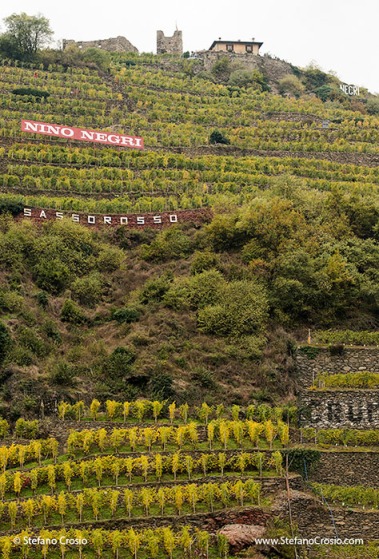

Valtellina mountain vineyardsA8. The Valtellina district of Lombardia counts a little over 800 HA of vineyards altogether, and our grapevines grow on mountain slopes at an average altitude ranging from 400 to 600 mt (1,300 to 2,000 ft) above sea level. The soil here is scarce, as rocks abound.

This is also one of the main differences between the Grumello subzone versus the Sassella and Inferno subzones: the former has somewhat more soil, it is less rocky and this makes for easier, readier to drink wines, whilst the latter subzones have very little soil and rocks prevail – this makes the wines coming from these areas more austere and dependent on longer aging periods to properly assemble and integrate their components and smooth their edges.

Q9. Now, regarding the commercial aspects of your business: your annual production is about 60,000 bottles – what is roughly the split between export and domestic consumption? Which are the top three countries to which you export?

A9. This year marks the first time that we export more than we sell domestically: 60% of our production has in fact been exported.

Geographically, the USA is the top country we export to, Japan is the second and Russia (which we just started exporting to this year) came in third. This year we also started selling to a few new countries beside Russia, among which Hong Kong, Taiwan and a market that we are excited to finally be in Canada – our Rosso di Valtellina will be soon available in Quebec and we are very excited about this new challenge.

Q10. Finally, are there any new projects that you are working on that are worth pointing out to our readers?


Ar.Pe.Pe.'s fermenting barrelsA10. Yes, definitely. We already talked about the two new Crus which will become available in 2018, for which we are very excited and feel very strongly about their quality and potential.

Beside such product news, from a viticultural perspective we have decided to convert our vineyards to the Simonit-Sirch pruning method for controlled grapevine growth. In the context of a Guyot-type training system like the one we use in our vineyards, this method has the objective to optimize the performance of each vine through selective pruning of only young (one or two year old) stems growing out of the head of the trunk.

The purpose of this is to cause the vine to develop two main stems that originate from opposite sides of the head of the trunk and run parallel to the bending wire, giving the vine a characteristic T-shape. This optimizes the canalization of the plant’s lymph into such two main vessels and makes a vine grown with a Guyot-type training system more similar to a free-standing bush vine, which nowadays is considered the most efficient vine training system and one that considerably increases the life expectancy of the vine.


Ar.Pe.Pe.'s stunning tasting room

That’s all: hope you enjoyed the read, and let me thank Isabella once again for her exquisite hospitality and for being so patient as to answer all of my questions! 🙂

Posted in Meet the Maker, Wine, Wine Education | Tagged , , , , , , , , , , , , , , , | 7 Comments

Meet the Maker: History and Wine Tasting of One of Valtellina’s Finest: Ar.Pe.Pe.

On our previous post, we have presented the Italian wine district of Valtellina, its territory, history, dominant grape variety and just briefly, its wines. Now is the time to focus on one of the finest producers of Valtellina wines, Ar.Pe.Pe. (pronounced “Ahr-Pay-Pay”).

Ar.Pe.Pe.’s History

The somewhat curious name of this premium Valtellina winery is an acronym that stands for ARturo PEllizzatti PErego, that is the full name of the winery’s founder.


Ar.Pe.Pe.'s stunning tasting room

Arturo was the descendant of a Valtellina family who had been in the wine industry since 1860 and who, by the 1960’s, had grown to own or manage 50 HA of vineyards. Arturo’s father, Guido, had built the family business’s winery by carving it into the rock of those very mountains on the slopes of which their vineyards lay: the new winery became operational in 1961.

Guido’s death in 1973 resulted in a paralizing feud among his heirs over the allocation of his estate: because of this, the heirs decided to sell the family’s business and the “Pellizzatti” brand to a then large wine and food conglomerate to which the family also leased the vineyards for a 10 year term.


Ar.Pe.Pe.'s fermenting barrelsIn 1983, however, upon the expiration of the vineyard lease term, Arturo claimed back his own portion of the family’s vineyards (12 HA), bought back the winery that his father had built and started afresh his own wine business, under the current Ar.Pe.Pe. brand.

Arturo devoted all his knowledge, experience and energy into creating a range of top quality wines that would underscore and maximize the potential of the mountain Nebbiolo grapes and Valtellina’s unique terroir. In so doing, he took his chances and from the very beginning he decided not to compromise on anything, aiming for top of the line wines that would be optimally aged by the time they were released to the market.

This meant that for the first six years following Ar.Pe.Pe.’s creation, their vineyards were harvested for six times, wine was made for each vintage, but not a single bottle was released to the market because of the very long aging times that Arturo had prescribed for his wines. This is what his heirs affectionately refer to as his “nostalgic hardheadedness“.

But when the first bottles of one of his top Crus, the Valtellina Superiore “Rocce Rosse”, were finally made available to retailers in 1990, all those sacrifices paid off and the immediate success and rave reviews proved that Arturo’s philosophy of unwavering commitment to excellence had been right and long sighted.

Ar.Pe.Pe. then quickly became one of the most respected and prestigious brands in the landscape of Valtellina’s Nebbiolo’s. In 2004, Arturo passed away and his legacy passed on to his three children: Isabella (who became Ar.Pe.Pe.’s enologist), Guido and Emanuele, who have since shared the leadership of the family business.

Isabella, 
Ar.Pe.Pe.'s enologist and co-owner, with her brother Emanuele in their tasting room

Ar.Pe.Pe.’s Wine Tasting

On the next post, we will publish our interview of Isabella Pellizzatti Perego, Ar.Pe.Pe.’s enologist and co-owner, but before that here are my quick tasting notes (i.e., these are not full-blown wine reviews) for those wines in Ar.Pe.Pe.’s lineup that had just been released to the market at the time of my visit and that my gracious hostess Isabella was kind enough to let me taste:

  • ArPePe, Rosso di ValtellinaRosso di Valtellina DOC 2011 (13% ABV)

This is Ar.Pe.Pe.’s entry-level wine, made from 100% Nebbiolo grapes harvested from their lower altitude vineyards (1,150/1,300 ft – 350/400 mt above sea level) in the Grumello and Sassella subzones (for more information, refer to our introductory post to the Valtellina district). The wine ages 6 to 12 months in large wood barrels before being released to the market. The Rosso di Valtellina retails in the US for about $32.

Tasting Notes: The wine’s color was ruby red, with aromas of violet, cherry and raspberry. In the mouth, the wine was freshly acidic, with smooth tannins – a young, easy to drink, ready to be enjoyed red.

Rating: Good Good

  • Valtellina Superiore Sassella “Stella Retica” Riserva DOCG 2006 (13% ABV)

ArPePe, Valtellina Superiore Sassella "Stella Retica" RiservaThis is the second vin of Ar.Pe.Pe.’s two grand vins in the Sassella subzone (the “Rocce Rosse” and the single-vineyard “Vigna Regina”). As will be better explained in our interview of Ar.Pe.Pe.’s enologist, the Stella Retica is only made in those vintages when the Rocce Rosse is not released (i.e., for any given vintage, either one of the Rocce Rosse or the Stella Retica is made).

The Stella Retica is made from 100% Nebbiolo grapes grown at an altitude between 1,300 and 1,650 feet (400 to 500 meters). It ferments in Ar.Pe.Pe.’s signature mixed wood fermenting barrels (more about this in our interview of Ar.Pe.Pe.’s enologist) for 12 days and ages in large wood barrels for 24 months, plus 24 additional months of in-bottle aging. The Stella Retica retails in the US for about $48.

Tasting Notes: The wine’s color was ruby red with garnet reflections, with a fine and intense bouquet of cherry, wild strawberry and mineral hints of granite. In the mouth, the wine was dry, with high ABV and smooth; it was freshly acidic, gently tannic, and tasty, with medium body. All in all, a very pleasant and enjoyable wine.

Rating: Very Good Very Good

  • Valtellina Superiore Sassella “Rocce Rosse” Riserva DOCG 2002 (13% ABV)

ArPePe, Valtellina Superiore Sassella "Rocce Rosse" RiservaThe Rocce Rosse is one of Ar.Pe.Pe.’s two grand vins for the Sassella subzone (in addition to the single-vineyard Vigna Regina): it is made from 100% Nebbiolo grapes grown in the Sassella subzone only in those years in which the quality of the harvest is extraordinary. It ferments in wood fermenting barrels for 40 days(!) and it ages in large oak, chestnut and acacia wood barrels for 48 months, plus 36 additional months of in-bottle aging.

The Rocce Rosse is a top of the line wine that is suitable for long-term aging. It retails in the US for about $72.

Tasting Notes: The wine’s color was garnet, with a spectacular, complex and intense bouquet of cherry, raspberry, cocoa, nutmeg and hints of tobacco, licorice and minerals (granite). In the mouth, the wine was dry, with high ABV and silky smooth; it was acidic, gently tannic, and tasty, with full body and a long finish. A spectacularly exciting wine, already perfectly balanced and integrated after 11 years: a true sensory pleasure to be enjoyed with red meat or game dishes.

Rating: Spectacular Spectacular

  • Valtellina Superiore Sassella “Ultimi Raggi” Riserva DOCG 2006 (14% ABV)

ArPePe, Valtellina Superiore Sassella "Ultimi Raggi" RiservaThe Ultimi Raggi is Ar.Pe.Pe.’s late-harvest dry wine, made from 100% Nebbiolo grapes grown in the Sassella subzone vineyards at the highest altitude (about 1,950 feet/600 meters above sea level) and left on the vines to naturally dry and therefore concentrate and maximize sugar levels through a late harvest.

The wine is fermented for 20 days in wood fermenting barrels and aged for 24 months in large wood barrels, plus 12 additional months of in-bottle aging. The Ultimi Raggi retails in the US for about $79.

Tasting Notes: The wine’s color was garnet, with a complex, intense and explosive bouquet of spirited cherry, strawberry jam, raspberry, red fruit candy, cocoa, tobacco. In the mouth, the wine was dry, with high ABV and smooth; it was acidic, with supple tannins, and tasty, with mineral hints of granite. It was full-bodied and with a long finish. An outstanding, structured and masterfully balanced wine: the perfect companion for structured red meat or game dishes or seasoned cheeses.

Rating: Spectacular Spectacular

Posted in Meet the Maker, Red Wines, Wine, Wine Education, Wine Reviews | Tagged , , , , , , , , , , , , , , , , , , , , | 5 Comments