
LOMBARDIA’s DOCGs
(Click on any grape variety to see its record on our
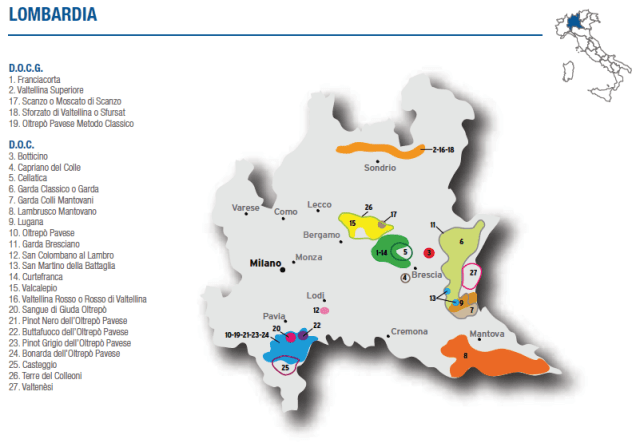
Wine Map of Lombardia – Courtesy of Federdoc (click on map to go to website)
1. Franciacorta DOCG
Approved as a DOC in 1967
Upgraded to DOCG in 1995
Permitted Type of Wine: Reserved to sparkling wines made according to the Classic (or Champenoise) Method
Territory: areas adjancent to the towns of Paratico, Capriolo, Adro, Erbusco, Cortefranca, Iseo, Ome, Monticelli Brusati, Rodengo Saiano, Paderno Franciacorta, Passirano, Provaglio d’Iseo, Cellatica e Gussago, nonché la parte del territorio dei comuni nonché la parte del territorio dei comuni di Cologne, Coccaglio, Rovato, Cazzago S. Martino, all in the Brescia district
Subzones: N/A
Permitted Varieties: 50% or more Chardonnay and/or Pinot Noir, with the remaining up to 50% being Pinot Bianco – however, Pinot Noir grapes are not permitted in the Satèn version
Minimum Aging:
(1) For the base wine: 18 months in wooden barrels;
(2) For the “Franciacorta Satèn” version or the “Franciacorta Rosé” version: 24 months, at least 18 of which in wooden barrels;
(3) For any vintage Franciacorta version: 30 months, at least 18 of which in wooden barrels;
(4) For any Riserva version: 60 months, at least 18 of which in wooden barrels
2. Moscato di Scanzo DOCG
Approved as a DOC in 2002
Upgraded to DOCG in 2009
Permitted Type of Wine: Reserved to sweet red raisin wines
Territory: areas adjancent to the town of Scanzorosciate, in the Bergamo district
Subzones: N/A
Permitted Varieties: 100% Moscato di Scanzo, whose grapes must be left to dry after harvesting for a period of not less than 21 days
Minimum Aging: 24 months
3. Oltrepò Pavese Metodo Classico DOCG
Approved as a DOC in 1970
Upgraded to DOCG in 2007
Permitted Type of Wine: Reserved to sparkling wines made according to the Classic (or Champenoise) Method
Territory: areas adjancent to the towns of Borgo Priolo, Borgoratto Mormorolo, Bosnasco, Calvignano, Canevino, Canneto Pavese, Castana, Cecima, Godiasco, Golferenzo, Lirio, Montalto Pavese, Montecalvo Versiggia, Montescano, Montù Beccaria, Mornico Losana, Oliva Gessi, Pietra de Giorgi, Rocca de Giorgi, Rocca Susella, Rovescala, Ruino, San Damiano al Colle, Santa Maria della Versa, Torrazza Coste, Volpara, Zenevredo e per parte dei territori di questi altri comuni: Broni, Casteggio, Cigognola, Codevilla, Corvino San Quirico, Fortunago, Montebello della Battaglia, Montesegale, Ponte Nizza, Redavalle, Retorbido, Rivanazzano, Santa Giuletta, Stradella, Torricella Verzate, all in the Pavia district
Subzones: N/A
Permitted Varieties:
(1) For “Oltrepò Pavese” or “Oltrepò Pavese Rosé” wines: 70% or more Pinot Noir, with the remaining up to 30% being Chardonnay, Pinot Grigio and/or Pinot Bianco;
(2) For “Oltrepò Pavese Pinot Nero” or “Oltrepò Pavese Pinot Nero Rosé” wines: 85% or more Pinot Noir, with the remaining up to 15% being Chardonnay, Pinot Grigio and/or Pinot Bianco
Minimum Aging:
(1) For the base wine: 15 months on its lees;
(2) For the vintage version: 24 months on its lees
4. Sforzato della Valtellina DOCG
(Read our detailed article on Valtellina and its wines)
Approved as a DOC in 1968
Upgraded to DOCG in 2003
Permitted Type of Wine: Reserved to red raisin wines
Territory: (i) areas between the towns of Ardenno and Tirano plus areas adjacent to the towns of Piateda and Ponte in Valtellina on the right banks of the Adda river and (ii) areas adjacent to the towns of Villa di Tirano and Albosaggia on the left banks of the Adda river
Subzones: N/A
Permitted Varieties: 90% or more Nebbiolo grapes (locally known as “Chiavennasca“), with the remaining up to 10% being any black-berried grape variety permitted in Lombardia
Minimum Aging: 20 months, at least 12 of which in wooden barrels
5. Valtellina Superiore DOCG
(Read our detailed article on Valtellina and its wines)
Approved as a DOC in 1968
Upgraded to DOCG in 1998
Permitted Type of Wine: Reserved to red wines
Territory: areas adjacent to the towns of Berbenno di Valtellina, Bianzone, Buglio in Monte, Castione Andevenno, Chiuro, Montagna in Valtellina, Poggiridenti, Ponte in Valtellina, Postalesio, Sondrio, Teglio, Tirano, Tresivio and Villa di Tirano, all in the Sondrio district
Subzones: “Maroggia”; “Sassella”; “Grumello”; “Inferno”; “Valgella”
Permitted Varieties: 90% or more Nebbiolo grapes (locally known as “Chiavennasca“), with the remaining up to 10% being any black-berried grape variety permitted in Lombardia
Minimum Aging:
(1) For the base wine: 24 months, at least 12 of which in wooden barrels;
(2) For the Riserva wine: 36 months, at least 12 of which in wooden barrels







 Flora's Table